
Updated October 2026 · By Sia — Victory Rental & Safaris
The longest route isn’t automatically the best choice. Kilimanjaro climbing packages differ by route, time on the mountain, and the guide, porter, and safety support included. Choose an itinerary that balances your preferred challenge with enough time to prepare for the summit. Routes include Machame, Lemosho, Marangu, Rongai, and the Northern Circuit.
It’s natural to focus on the mountain’s extraordinary landscapes and the moment you reach the roof of Africa. But the details behind the climb matter too: route length shapes your pace, package inclusions determine what you need to arrange, and clearly stated safety provisions explain the support available along the way.
This guide compares the main routes and explains what affects package costs, what guide and porter support can involve, and which safety details to review. You’ll also find a practical way to assess an operator and itinerary, so you can move from dreaming about Kilimanjaro to planning your climb with greater confidence.
A guided climb brings together the route plan, mountain crew, camp logistics, and daily trekking rhythm. On Kilimanjaro, trekkers require a guide and at least one porter. A tour provides an organized way to arrange essential mountain support while you focus on preparation and acclimatization.
Compare route, duration, group size, and inclusions rather than relying on the package label alone. “Classic” and “Premium” aren’t universal standards: one operator’s Premium package may include hotel nights or upgraded equipment, while another may define it differently. Compare written itineraries line by line, including accommodation before and after the climb, transfers, meals, park-related costs, and equipment. A higher package tier is worthwhile only when its additional inclusions suit your plans.
Duration is a practical starting point. For example, a 6-day Marangu itinerary differs from an 8-day Lemosho climb in route and time on the mountain. Longer itineraries can allow a more gradual schedule, while route choice shapes the daily journey. The quoted total also depends on whether you join an open group or arrange a private climb. For a fair comparison, match the route, travel dates, duration, group arrangement, and listed inclusions before weighing prices.
Group size affects the feel of the trek and the level of personal attention. One listed 7-day Lemosho package sets a maximum shared group size of 10 climbers. A separate operator states a guide-to-client ratio of one guide per two clients. Treat those as examples, not universal standards: check the group limit and guide ratio shown for the specific itinerary you’re comparing. Smaller groups may offer a quieter shared experience; larger groups can change the pace and dynamics on the trail.
Season matters too. July to October and January and February are described as the driest, most pleasant climbing periods, while January, February, and September are also considered favorable trekking months. Weather can affect trail conditions, comfort, and what you pack. Choose an itinerary suited to your travel window and prepare for changing mountain conditions.
Before choosing, compare the itinerary’s acclimatization schedule, group size, guide support, porter arrangements, and clearly stated inclusions. Compare like with like: a shorter route and a longer trek aren’t the same experience, even when their package labels sound similar. A thoughtful match helps you arrive prepared for the climb.
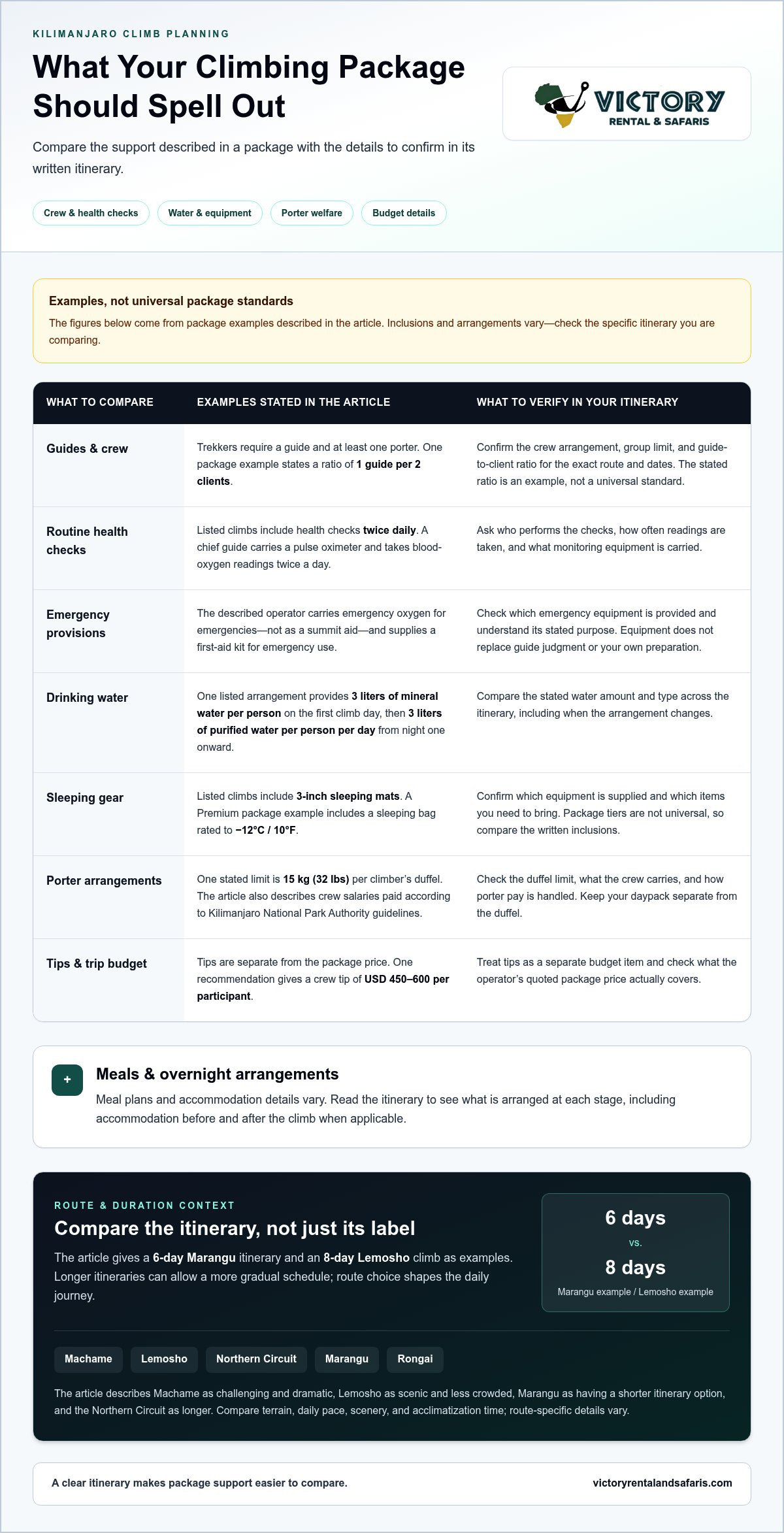
Support on Kilimanjaro includes people, equipment, meals, and overnight arrangements, but package details vary. For example, listed climbs include 3-inch sleeping mats, while a Premium package includes a sleeping bag rated to -12°C/10°F; the itinerary should specify meal and accommodation arrangements.
Ask what medical checks guides perform and what equipment they carry. One package description states a guide-to-client ratio of one guide per two clients, while listed climbs include health checks twice daily. A chief guide carries a pulse oximeter and takes blood-oxygen readings twice a day, allowing the crew to monitor climbers regularly during the trek.
Emergency provisions matter too. The described operator carries emergency oxygen for emergencies, not as a summit aid, and supplies a first-aid kit for emergency use. These examples show why an itinerary should distinguish routine monitoring from emergency equipment. Review stated safety provisions alongside the route plan, rather than treating equipment as a substitute for guide judgment or your own preparation.
Meals, water, and accommodation deserve the same careful reading. One listed arrangement provides 3 liters of mineral water per person on the first climb day, then 3 liters of purified water per person per day from night one onward. Compare the package’s meal plan and overnight accommodation details with its itinerary, so you understand what is arranged at each stage.
Camping equipment is another practical comparison point. A 3-inch mat and the Premium sleeping bag rating are concrete examples, but equipment varies by package. Check which items are supplied and which you must bring; this helps you prepare without packing unnecessary gear for the mountain.
Porters carry duffel bags between camps, with one stated maximum of 15 kg (32 lbs) per climber’s bag. Keep your daypack separate, and pack the duffel within its limit. A package should make porter arrangements understandable, including what the crew carries and how the support team is organized for the trek.
Welfare also involves pay and tipping. One stated approach is to pay mountain crew salaries according to Kilimanjaro National Park Authority guidelines. Tips are separate from the package price; one recommendation gives a crew tip of USD 450–600 per participant. Account for this when planning your travel budget, rather than treating tips as part of the advertised climb cost.
Responsible travel also means considering the people who make each camp-to-camp day possible. Look for clear porter weight limits, transparent crew-pay practices, and a realistic tipping plan. These details help you assess how a climb treats its support team and understand the work behind a successful trek.
Available itineraries include Machame, Lemosho, Northern Circuit, Marangu, and Rongai, with durations varying by route and schedule. Compare terrain, daily pace, scenery, and acclimatization time before choosing.
Machame is described as challenging and dramatic, while Lemosho offers scenic landscapes and a less crowded experience. Marangu has a shorter itinerary option, and the Northern Circuit offers a longer route choice. Rongai approaches Mount Kilimanjaro from the north, providing another direction of ascent.
Published itinerary lengths vary: Machame is offered as a 6-day climb, while Lemosho options range from 6 to 8 days. Northern Circuit itineraries include 8-day, 9-day, and 10-day versions. Compare the daily route plan, not just the total days, because camps and the ascent sequence shape each trek.
Mount Kilimanjaro reaches 5,895 meters above sea level. On the Machame route, the named camps show how quickly the trail climbs: Machame Camp sits at 2,980 meters, Shira Camp at 3,840 meters, and Barafu Camp at 4,550 meters.
These elevations help put the itinerary into perspective. Shira Camp is already above 3,000 meters, while Barafu Camp is above 4,000 meters, where cold and low oxygen can make nights uncomfortable. Compare how each itinerary moves between camps and how much time it allows for acclimatization, rather than judging difficulty by total distance alone.
Marangu is often sold as a 5-day, 4-night return trek, but adding at least one day for safer acclimatization is advised. That extra time changes the schedule, so compare the itinerary’s ascent and descent days before selecting a shorter option.
For a dramatic trail, Machame is a challenging choice; Lemosho combines scenic trekking with fewer crowds. Northern Circuit itineraries offer longer-duration options, while Marangu’s shorter standard schedule makes acclimatization time an especially important comparison point. Route descriptions convey a trek’s character, but the itinerary reveals its actual pace.
No single route suits every climber. Consider how you handle sustained uphill trekking, whether solitude or a more established route matters most, and how much time you can devote to a gradual ascent. Longer schedules can provide more time on the mountain, but the route’s actual camp sequence remains central to acclimatization.
Use a simple comparison: match your available travel days to the route duration, review camp elevations, then weigh scenery and crowd preferences. A summit attempt reaches high altitude, where oxygen is limited, so choose a schedule that prioritizes acclimatization over speed. A measured approach supports a more prepared climb, though no route or itinerary can promise summit success.
In 2026, the cost of a Kilimanjaro climb depends on route, itinerary length, package tier, and group arrangement. Compare those details together; a shorter Machame trek and a longer Lemosho itinerary aren’t equivalent just because both lead toward the summit.
Use the written itinerary to see what the quoted total covers and which trip expenses fall outside it. The route, accommodation plan, crew support, and stated inclusions are more useful comparison points than a package label alone.
Typical 2026 price ranges for a guided climb, all-in (confirm current rates — group size, season and inclusions move these):
| Package | Days | Typical price (USD pp) |
|---|---|---|
| Marangu (huts) | 5–6 | US$1,600–2,400 |
| Machame (camping) | 6–7 | US$1,800–2,600 |
| Rongai (camping) | 6–7 | US$2,000–2,900 — our 6-day Rongai starts at US$2,890 |
| Lemosho (camping) | 7–8 | US$2,400–3,300 |
| Northern Circuit (camping) | 8–9 | US$3,000–4,200 |
Why the spread? Park fees are fixed (~US$70/day entry + US$50/night camping + US$20 rescue levy ≈ US$700–900 pp over 7–8 days). Below ~US$1,500, something is being skipped — usually crew pay, food quality, or emergency equipment. Above US$4,000 you’re paying for luxury add-ons (private toilets, walk-in tents), not safety.
Whatever the price, a legitimate package should state all of these in writing:
Red flags: no named route, "full support" with nothing specified, prices far below the table above, or pressure to skip the acclimatization day to save money.
Start with the itemized inclusions. Check whether the itinerary lists accommodation before and after the climb, airport transfers, meals, drinking water, camping equipment, park fees, and rescue service. Package arrangements differ, so count an item as included only when the itinerary says so. This makes it easier to compare the actual scope of two offers.
Then identify expenses handled separately. Personal travel arrangements, equipment you bring yourself, and crew tips can affect your overall trip budget. The earlier porter guidance explains why tipping deserves its own budget line. Separate package inclusions from personal costs before deciding whether an itinerary offers better value.
Compare Machame and Lemosho by matching their itinerary lengths and group formats. A 6-day Machame climb and an 8-day Lemosho climb differ in time on the mountain, route experience, and acclimatization schedule. A longer itinerary involves more trekking days, so compare the complete schedule rather than treating either route as a like-for-like option.
Package tiers also affect what the total represents. A Classic or Premium label has no universal definition; the accommodation, equipment, and services included determine its practical value. For example, compare a hotel night or sleeping bag only when the package explicitly includes it. This keeps your comparison grounded in the actual trip plan.
Read each tour price alongside its day-by-day itinerary. Check the route name, climb and descent schedule, pre-climb arrangements, and listed support. An 8-day Lemosho tour and a 9-day Northern Circuit tour use different routes and durations, so the headline total alone can’t tell you which better suits your plans.
Group size is another cost factor to understand. An open-group trek shares the scheduled experience with other climbers, while a private arrangement is organized around its own party. Check the group format described in the itinerary and compare it with the stated guide support and inclusions. If your Africa adventure also includes a safari or time in Arusha, assess those plans separately from the Kilimanjaro trek when comparing package scope.
Choose a Tanzania operator by comparing the written itinerary, included services, safety plan, and payment terms. A polished description of Mount Kilimanjaro matters less than a clear day-by-day plan you can understand before booking.
Start with the exact route and daily schedule. The Marangu Route, Machame, Lemosho, and Northern Circuit differ in terrain and itinerary, so check that the proposal names your route and explains the ascent and descent plan. Look for a stated acclimatization schedule, camp sequence, and details of how the plan may adjust if the pace needs to change. These details show how the operator has structured the trek.
Next, compare inclusions item by item. A Classic package may include two hotel days beyond the climb, while another itinerary may describe accommodation differently. Check whether airport transfers, meals, mountain support, and equipment are stated in writing. One package description includes a private arrival transfer and a private departure transfer between Kilimanjaro Airport and the hotel, with one transfer of each type per group. Compare that arrangement with your travel party.
Park charges can affect the total, so find out how the package handles them. Some climb packages include Kilimanjaro National Park fees and prepaid rescue service. Before paying a deposit, confirm the official TANAPA/NCAA tariff for your travel dates, as the applicable tariff can change the amount due. Keep fee details distinct from accommodation, transfers, and other trip costs.
Review the safety plan as carefully as the route. Check which medical checks, emergency equipment, and evacuation arrangements the itinerary describes, and understand who leads decisions on the mountain. A package that names its support provisions gives you a clearer basis for comparison than a general promise of “full support.” Match the stated provisions to the length and character of your chosen trek.
Find out whether the itinerary is open-group or private, and how it defines group size. An open-group climb means sharing the scheduled trek with other climbers; a private arrangement is organized for your party. The difference can affect the social feel of the trip and how the schedule is organized. Make sure the quoted plan reflects the group format you intend to book.
Finally, separate the mountain journey from any wildlife or safari extension. A combined Tanzania itinerary can add memorable landscapes, but its safari days, transport, and accommodation should be clearly described alongside the climb rather than blurred into one vague total. Use a written comparison of route, schedule, inclusions, fees, safety provisions, and group format to reach a confident decision. Explore Kilimanjaro climbing options in Tanzania as you shape your travel plan.
When you’re ready to pair a Kilimanjaro climb with a safari, Victory Rental & Safaris can help plan the next part of your Tanzania journey. Its Serengeti Great Migration and Great Migration Tanzania Tour offerings suit travelers drawn to wildlife journeys, while the Masai Mara to Serengeti & Ngorongoro Safari Adventure brings several celebrated destinations together in one named experience.
If you’d rather begin your safari from the coast, Mikumi Safari from Zanzibar offers another way to extend your travels. Consider these options after settling your climb route and dates, then decide whether a wildlife adventure belongs before or after the mountain. Before you go, see our Kilimanjaro training plan, the Rongai route plan and our guide to combining Kilimanjaro and a family safari. To discuss your Tanzania plans, contact Victory Rental & Safaris or visit victoryrentalandsafaris.com.
Let the climb become the starting point for a journey shaped around what you want to remember: the quiet of the trail, the exhilaration of reaching high ground, or the wildlife and landscapes beyond the mountain. The best Kilimanjaro climbing packages fit your priorities and leave room to enjoy the experience, rather than simply ticking off an itinerary.
As you move from comparing options to planning, write down what matters most, then use it to guide your decisions. You might want a focused trekking holiday, or you may be dreaming of a broader Tanzania adventure. Either way, a thoughtful plan gives the journey its own rhythm, from preparation to the moments you’ll carry home.
Ready to shape your Tanzania travel plans? Contact Victory Rental & Safaris to begin a conversation. Your next great story can start with one clear step.
Kilimanjaro is a demanding high-altitude trek, even though standard routes don’t require technical mountaineering experience. Long uphill days, uneven trails, cold nights, and thinner air make steady pacing important. The physical challenge also depends on your route and how comfortably you manage consecutive days of walking. Prepare with regular hikes and gradual fitness training, and choose an itinerary that allows time to adjust to altitude.
Porters carry a climber’s duffel between camps, with a stated maximum bag weight of 15 kg (32 lb). You’ll carry your own daypack while trekking, so keep it practical: water, layers, sun protection, and personal essentials you may need on the trail. Weigh your packed duffel before departure and remove nonessential items if it exceeds the limit. Your daypack is separate from the porter-carried duffel.
Yes, beginners can attempt standard Kilimanjaro routes without special mountaineering experience or equipment. The climb still requires preparation because it involves sustained walking at altitude over multiple days. Build your walking stamina before travel, practise on hills or uneven trails, and get comfortable carrying a daypack. First-time trekkers should choose an itinerary with gradual pacing rather than treating summit speed as the goal.
Climb itineraries range from shorter options to longer treks, and their listed duration generally describes the route schedule. For example, a 6-day Rongai itinerary and an 8-day Lemosho itinerary provide different amounts of time on the mountain. Acclimatization time depends on the route’s day-by-day plan. For Marangu, a 5-day, 4-night return trek is commonly sold, with at least one additional day advised for safer acclimatization.
Budget US$1,600–4,200 per person depending on route and length: Marangu 5–6 days from approximately US$1,600, Machame 6–7 days approximately US$1,800–2,600, Lemosho 7–8 days approximately US$2,400–3,300, and Northern Circuit 8–9 days approximately US$3,000–4,200. Our 6-day Rongai package starts at US$2,890. Tips and personal gear are additional. See the price table above for what is included at each level.
Begin by choosing your travel window, then match it to a route and realistic itinerary. Set aside time to build walking fitness, check your gear against expected conditions, and plan how you’ll reach the climb’s starting point. Keep copies of your itinerary and essential travel documents together. If you’re combining trekking with other Tanzania plans, allow enough time for each part rather than squeezing everything into a tight schedule.
A typical trekking day starts with breakfast and a guide’s outline of the trail ahead. Climbers walk at a measured pace, pausing for rest and food before continuing toward the next camp. On arrival, the crew helps establish the evening routine, followed by a meal and preparations for the next day. Walking hours and camp schedules vary by route, altitude, and itinerary.
There isn’t one useful average for every climb because shared-group sizes and private arrangements differ. One listed 7-day Lemosho itinerary sets a maximum shared group size of 10 climbers, but that limit doesn’t tell you how many people will join a particular departure. Compare the published maximum with the actual group format and guide support described for your chosen itinerary.
Related reading
{“@context”:”https://schema.org”,”@type”:”FAQPage”,”mainEntity”:[{“@type”:”Question”,”name”:”How difficult is a Kilimanjaro trek?”,”acceptedAnswer”:{“@type”:”Answer”,”text”:”Kilimanjaro is a demanding high-altitude trek, even though standard routes do not require technical mountaineering experience. Long uphill days, uneven trails, cold nights, and thinner air make steady pacing important. Prepare with regular hikes and gradual fitness training, and choose an itinerary that allows time to adjust to altitude.”}},{“@type”:”Question”,”name”:”Approximately how much weight will climbers carry?”,”acceptedAnswer”:{“@type”:”Answer”,”text”:”Porters carry a climber’s duffel between camps, with a stated maximum bag weight of 15 kg (32 lb). You carry your own daypack while trekking, so keep it practical with water, layers, sun protection, and personal essentials.”}},{“@type”:”Question”,”name”:”Can a beginner hike Kilimanjaro?”,”acceptedAnswer”:{“@type”:”Answer”,”text”:”Yes, beginners can attempt standard Kilimanjaro routes without special mountaineering experience or equipment. The climb still requires preparation because it involves sustained walking at altitude over multiple days.”}},{“@type”:”Question”,”name”:”How long do I need to complete the climb and does that include time to acclimatize?”,”acceptedAnswer”:{“@type”:”Answer”,”text”:”Climb itineraries range from shorter options to longer treks, and their listed duration generally describes the route schedule. Acclimatization time depends on the route’s day-by-day plan.”}},{“@type”:”Question”,”name”:”How much does a Kilimanjaro climbing package cost in 2026?”,”acceptedAnswer”:{“@type”:”Answer”,”text”:”Budget US$1,600–4,200 per person depending on route and length. Tips and personal gear are additional.”}},{“@type”:”Question”,”name”:”What does a typical day look like on a Kilimanjaro climb?”,”acceptedAnswer”:{“@type”:”Answer”,”text”:”A typical trekking day starts with breakfast and a guide’s outline of the trail ahead. Climbers walk at a measured pace, pausing for rest and food before continuing toward the next camp. Walking hours and camp schedules vary by route, altitude, and itinerary.”}},{“@type”:”Question”,”name”:”What is the average number of climbers?”,”acceptedAnswer”:{“@type”:”Answer”,”text”:”There is no one useful average for every climb because shared-group sizes and private arrangements differ. Compare the published maximum with the actual group format and guide support described for your chosen itinerary.”}}]}