
Across Kilimanjaro, summit success estimates commonly range from 65% to 85%. The success rate for the Rongai Route on Kilimanjaro is reported at about 65% to 80%, with estimates varying by itinerary length and operator.
It’s natural to want one clear figure before choosing a climb, but reported summit rates can measure different things. A shorter itinerary allows less time to adjust to altitude, and operators may calculate and report their results differently.
This guide explains how Rongai summit estimates compare across itinerary lengths, why figures vary between operators, and what they can and can’t tell you about your own chances of reaching Uhuru Peak. It also shows how to weigh the route’s gradual ascent against the time allowed for acclimatization, so you can plan with realistic expectations.
Across Kilimanjaro, overall summit success estimates commonly range from 65% to 85%. These figures vary by itinerary, route profile, and how operators count summit attempts.
A Rongai climb’s total cost depends on the itinerary and package inclusions, such as park fees and guide services. A six-day and a seven-day schedule differ in length, so compare what each includes rather than assuming there is one fixed total.
Itinerary length is the number of days available for trekking and adjusting to altitude. On Kilimanjaro, a seven- to nine-day climb allows more acclimatization time than a five- to six-day trek. This matters because altitude sickness is the biggest factor preventing climbers from reaching the summit.
More days can allow a measured ascent instead of compressing the same elevation gain into fewer stages. The Rongai Route climbs gradually, but its climb-high, sleep-low profile is less favorable than some other routes. This helps explain why the route name alone cannot predict how well a climber will adjust.
Acclimatization is the body’s adjustment to thinner air as a climb gains elevation. Kilimanjaro reaches 5,895 metres, so the time spent ascending matters: a longer itinerary allows more time at altitude before the summit push.
The standard seven-day Rongai itinerary includes a dedicated acclimatization day on day four. The six-day version removes the acclimatization day at Mawenzi Tarn, reducing the time available to adapt. This is a practical difference between schedules, not simply an extra day of scenery. More time does not guarantee a summit, but it changes the pace of the climb.
Summit success on Rongai depends on itinerary length, acclimatization, and the route’s elevation profile. The route begins at First Cave, around 2,600 metres, and passes Mawenzi Tarn at 4,330 metres. Those elevations show why the daily ascent and rest pattern matter across the climb.
Rongai’s gradual ascent is one feature; its less favorable climb-high, sleep-low profile is another. Weather and each climber’s response to altitude also affect whether the summit attempt can continue. Compare the itinerary details, especially the acclimatization day and the time allowed before the highest stages, rather than treating one route-wide percentage as a personal forecast.
Reported summit estimates for the Rongai Route range from 65% to 80%, although some operator figures fall outside that range. The rongai route kilimanjaro success rate depends partly on itinerary length and on which climbers an operator includes in its calculations.
Altitude sickness is a health response to gaining elevation and is identified as the biggest factor preventing climbers from summiting Mount Kilimanjaro. If symptoms develop during the ascent, continuing toward Uhuru Peak may no longer be possible.
On Rongai, climbers pass Mawenzi Tarn at 4,330 metres before reaching higher ground. How someone responds to altitude can affect whether a summit attempt continues. Weather also shapes conditions, particularly when cold or wind adds difficulty to the final stages. A route-wide percentage can’t capture each climber’s experience on a specific climb.
Climb duration is the number of days planned for the ascent and descent. It determines how much time the itinerary allows for acclimatization. Rongai climbs take six to seven days, with seven days as the standard itinerary.
Some reports estimate around 70% success for a six-day climb, while seven-day estimates range from about 70% to 85-90%. This spread reflects different operator datasets and itinerary definitions. The rongai route kilimanjaro success rate is more meaningful when compared with a figure for the same schedule and a clearly defined group.
Overall Kilimanjaro success estimates commonly range from 65% to 85%. Other figures refer to different groups or conditions: the park’s 2006 data reported 45% across all routes, while reported rates outside the rainy season are usually 75-80%. The rainy-season estimate is about 60%, so these values shouldn’t be treated as one directly comparable set.
Rongai operator reports also vary: some give estimates around 70%, others 80-90%, and one operator dataset reports 99%. That 99% figure describes the dataset, not a universal expectation. The sample, itinerary mix, and calculation method can all affect the percentage. Ask what the reported rate actually represents before comparing it with another figure.
Use percentages as context, not as a personal forecast. Compare the route, itinerary length, and group counted, then consider how the schedule supports acclimatization. For climbers weighing a Rongai itinerary, the Kilimanjaro Rongai Route trek is one option to consider alongside those reported estimates.
Rongai estimates depend on the itinerary and the group counted. Across operators, the estimated success rate is approximately 50% for the six-day climb and about 70% for the seven-day climb. Other reported figures are higher, so these estimates are best read as comparisons, not as one definitive forecast.
How difficult is the Rongai Route compared with other Kilimanjaro routes? Its ascent is more gradual, but its climb-high, sleep-low profile is less favorable than some alternatives. The route may feel less steep in places, but acclimatization and itinerary length still shape the challenge.
For six days, Rongai success estimates include around 70% in some reports, while cross-operator estimates are approximately 50%. For seven days, estimates include about 70% across operators, an average of 85%, and figures reaching 85-90%. This spread reflects different operator datasets and itinerary definitions, rather than a guaranteed improvement for every climber.
Route comparisons also shift with the schedule used. Machame and Lemosho estimates vary across reports, so route comparisons should be treated cautiously. Marangu figures range from 50-65%, and Northern Circuit estimates range from 85-95%. These ranges show why comparing route names alone can mislead: the number of days and the reporting group matter.
A summit success rate generally describes the share of climbers in a defined group who reach the summit. The denominator matters: a rate based on an operator’s guests may reflect a particular mix of itineraries, while a route-wide estimate covers a broader set of attempts. Reports may also combine different itinerary lengths, changing the percentage without any change to the mountain itself.
For a fair comparison, match three details: the route, the number of days, and the group counted. A six-day Rongai figure should not be compared directly with a seven-day Lemosho rate or a mixed-route average. Check whether the estimate is specific to an operator or covers the route more widely, then use the closest comparison to understand what the figure represents.
The practical takeaway is to treat itinerary length as part of the route, not a minor scheduling detail. A seven-day Rongai schedule allows more time than a six-day one, while the route’s gradual ascent and acclimatization profile also matter. Reported percentages can help frame your decision, but the itinerary behind the number tells you more than a headline summit success rate.
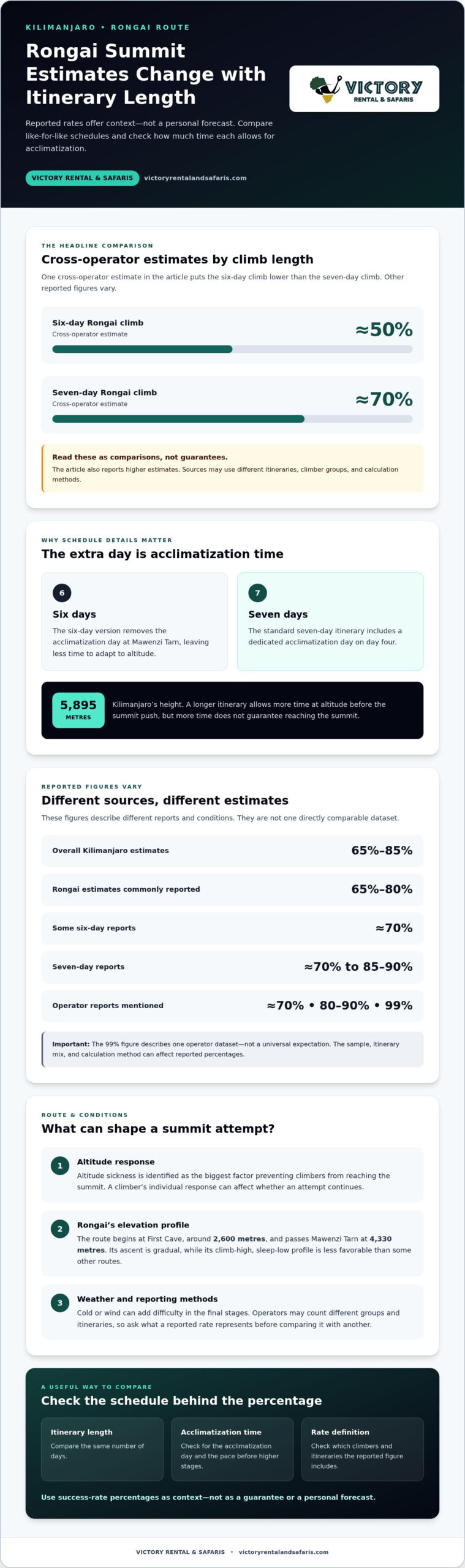
Rongai estimates vary with itinerary length and how operators calculate summit results. The clearest comparison is between the six-day and seven-day schedules, which allow different amounts of time for acclimatization.
A seven-day Rongai itinerary includes a dedicated acclimatization day on day four, giving the schedule more time to adjust before higher elevations. Reported success estimates range from about 70% across operators to 80%, with some figures reaching 85-90%.
Another estimate places the seven-day route’s average summit success rate at 85%. These figures describe different operator or route datasets, so treat them as a range of reported outcomes. The seven-day schedule matters because it preserves the Mawenzi Tarn acclimatization day.
A six-day Rongai itinerary removes the acclimatization day at Mawenzi Tarn. Reported summit estimates include around 70%, while the estimated success rate across operators is approximately 50%.
The gap between estimates can reflect different reporting groups rather than one agreed result. Compare the itinerary behind each figure: a reported six-day average may represent one operator’s climbers, while a cross-operator estimate covers a broader mix. Both show why a shorter schedule should be assessed on its own terms.
The main difference is the extra acclimatization time in the seven-day schedule, including the dedicated day at Mawenzi Tarn. The six-day version removes that day and compresses the route’s progression. This distinction helps you compare the actual climb rather than relying only on a headline percentage.
Figures also vary across routes. Reported estimates range from 85-90% for Lemosho to 85-95% for the nine-day Northern Circuit. The six-day Machame estimate is around 70-75%, while Marangu estimates range from 50-65%. These are not direct comparisons unless itinerary lengths and reporting methods align.
Rongai has a more gradual ascent, but its climb-high, sleep-low profile is less favorable than that of some routes. The trail’s feel underfoot and its acclimatization pattern are separate considerations. Altitude sickness remains a leading reason climbers don’t reach the summit, so added time can matter even when the trail feels manageable.
When comparing operators, look for the itinerary length, the acclimatization day, and whether the percentage refers to that operator’s climbers or a wider group. For example, compare a seven-day Rongai result with another seven-day Rongai result, not with a nine-day Northern Circuit figure. The route name alone doesn’t explain the difference.
Operator success rates are meaningful only when the measurement is clear. The Rongai Route Kilimanjaro success rate may describe individual climbers, whole groups, or a particular reporting period. These are different units of measurement, even when a report gives them the same label.
Start with the numerator: what does the operator count as a successful climb? Reaching Uhuru Peak is a clear summit outcome; reaching a lower point on the mountain is not the same result. The denominator matters just as much. A rate calculated per climber can differ from one calculated per expedition if a group has mixed outcomes.
Next, look at the scope of the report. A figure covering all of an operator’s Kilimanjaro climbs answers a different question from one limited to Rongai. Reporting periods matter, too: a result from one period reflects that group’s climbs, not every future departure. The phrase “summit success rate” alone doesn’t reveal these details.
Transparent reporting makes comparisons more useful. Look for a clear explanation of what counts as a summit, which climbs are included, and how the operator calculates the percentage. When a report explains its method, you can understand what the result represents without assuming it applies to every climber or itinerary.
This context changes how to interpret the Rongai Route Kilimanjaro success rate. Instead of choosing the most impressive headline, ask whether the measurement answers your question: does it describe Rongai climbers, and does it count reaching the summit? A clearly defined result is more useful for planning than a larger percentage without an explanation.
Use this measurement lens when discussing your climb and considering how it fits into a wider Tanzania journey. For example, explore Tanzania adventure planning if you’re considering what you’d like to experience beyond the mountain.
After a Kilimanjaro climb, Victory Rental & Safaris can help plan the next part of your Tanzania journey. If you’d like to trade high mountain trails for open savannah, explore its Serengeti Great Migration and Great Migration Tanzania Tour offerings.
For a broader itinerary, the Masai Mara to Serengeti & Ngorongoro Safari Adventure connects iconic landscapes across the region. If your plans begin in Zanzibar, the Mikumi Safari from Zanzibar offers another way to add wildlife travel. Choose the experience that best fits the journey you want beyond the mountain.
When you’re ready to explore a Tanzania safari or migration journey, contact Victory Rental & Safaris or visit victoryrentalandsafaris.com.
A summit goal can be the beginning of a much wider Tanzania story. As you consider the Rongai Route Kilimanjaro success rate, look beyond the percentage: what kind of experience do you want to carry home, and what would make the journey feel truly yours?
Choose a climb that reflects your priorities, then consider how the days around it can bring a different rhythm, from mountain stillness to the color and movement of the wild. Thoughtful planning connects these moments into one memorable adventure, rather than making the summit the whole story.
When you’re ready to explore how a Tanzania journey could take shape, connect with Victory Rental & Safaris. Bring your ideas, your hopes for the climb, and the experiences you’d love to add. The next chapter can begin with a simple conversation, and the mountain will be waiting when you’re ready.
A success rate is the proportion of climbers in a defined group who reach the summit. Its meaning depends on who is counted: an operator’s clients, climbers on one route, or a broader mix of Kilimanjaro attempts. For a useful comparison, look for the route, itinerary length, and group represented. A figure combining several schedules may not describe a specific Rongai climb.
There isn’t one best route for every first-time climber; itinerary length and acclimatization time are useful starting points. A seven- to eight-day climb is recommended for a better chance of reaching Uhuru Peak safely. Rongai offers a gradual ascent, though its climb-high, sleep-low profile is less favorable than some routes. Compare the full schedule, not just the route name.
Reported Rongai summit estimates commonly fall between 65% and 80%, depending on the itinerary, while some operator figures report higher results. Treat the range as context rather than a personal prediction. For example, a percentage based on one operator’s guests may reflect a different mix of climb lengths than a route-wide estimate. Check what group and schedule the figure describes.
Rongai estimates overlap with figures reported for other routes, so itinerary length and reporting scope matter. Reported estimates include 85-90% for Lemosho, 85-95% for the nine-day Northern Circuit, and 50-65% for Marangu. These ranges aren’t directly comparable unless they describe similar schedules and climber groups. Use them to frame a choice, not rank routes as guaranteed outcomes.
When allowing time to acclimatize is a priority, a seven-day Rongai itinerary is generally a stronger choice than a six-day one. The longer schedule includes an acclimatization day at Mawenzi Tarn, which the six-day version removes. Kilimanjaro climbs of seven to eight days are recommended for a better chance of reaching Uhuru Peak safely. Compare the actual itinerary, including its rest and ascent pattern.
The Rongai climb begins near Nale Moru, with First Cave at about 2,600 metres, and passes Mawenzi Tarn at 4,330 metres. The itinerary can include time for acclimatization and progress toward the Saddle between Mawenzi and Kibo. These elevation and schedule points help you understand the climb’s progression without assuming every operator uses identical daily stages.
Pay attention to new or worsening physical symptoms as the route gains elevation, and promptly tell your guide. Altitude sickness is identified as the biggest factor preventing climbers from reaching Kilimanjaro’s summit, so changes in how you feel matter during the ascent. The risk is relevant as Rongai rises from First Cave at about 2,600 metres toward Mawenzi Tarn at 4,330 metres.
The commonly recommended climbing periods are December to mid-March and late June to October. Weather and conditions can still vary during a trip, so the season alone doesn’t determine summit success. Reported overall success is about 60% during the rainy season, compared with usual estimates of 75-80% outside it. Consider seasonal conditions alongside itinerary length when planning your Rongai climb.