
What looks like one park-entry price can become several separate charges once you factor in your route, travel dates, and visitor category. Tanzania national park fees 2026 aren’t a single flat rate, and an older tariff page can be mistaken for current pricing.
Comparing safari budgets can be confusing: fees may be listed in different currencies, and park entry may not be the only charge on your itinerary. This guide explains which authority sets fees for each stop, which visitor categories may apply, and how to check the relevant charges before you travel.
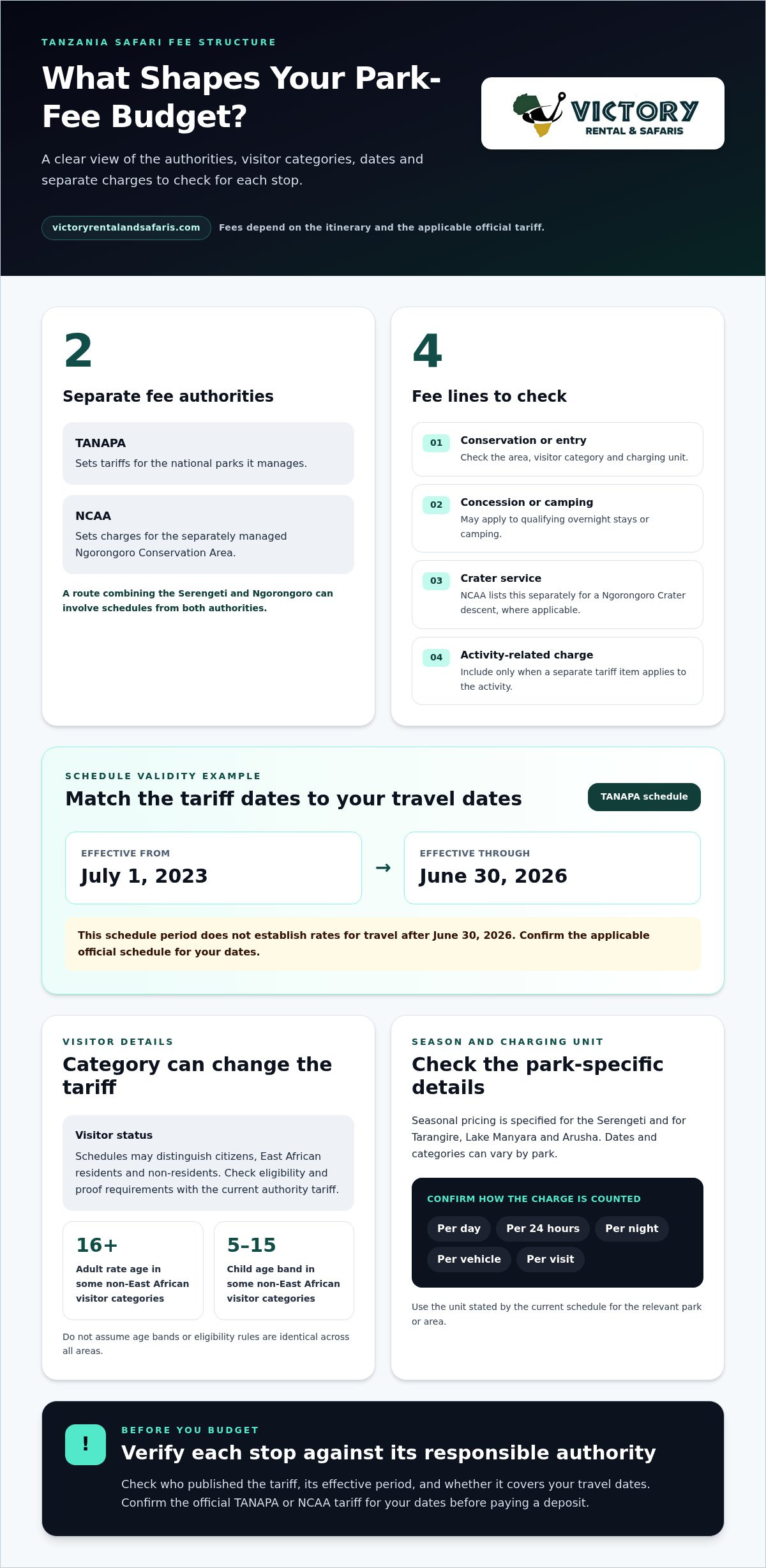
We’ll distinguish TANAPA-managed national parks from the separately managed Ngorongoro Conservation Area, then look at how visitor status, season, time in a park, and extras such as a crater descent or overnight stay can affect your budget. A TANAPA tariff schedule runs from July 1, 2023, through June 30, 2026, so matching a schedule’s effective dates to your travel dates is essential. With the fee structure clear, you can compare routes through the Serengeti, Ngorongoro, Tarangire, or Mikumi more confidently.
Park fees are official charges for entering or using protected areas. For a safari, the total may include charges for a national park visit or a specific use of a conservation area, rather than one universal entry price for every stop. The authority managing the area determines which tariff schedule applies.
Tanzania National Parks Authority (TANAPA) manages most of Tanzania’s national parks and publishes the tariff schedule for parks under its remit. The Ngorongoro Conservation Area is managed separately by the Ngorongoro Conservation Area Authority (NCAA), which publishes its own charges. TANAPA sets fees for the national parks it manages, while NCAA sets charges for the Ngorongoro Conservation Area.
This distinction matters on routes that combine, for example, the Serengeti and Ngorongoro. Don’t treat a Ngorongoro charge as a TANAPA fee just because both stops are part of one safari. Check the current tariff from the authority responsible for each area. Reposted tables and travel articles can help you identify what to look for, but may omit a schedule date or combine charges from different authorities.
A page’s publication date, a tariff’s effective period, and your travel date are three different things. A page published in 2026 may quote an earlier schedule, while a tariff labelled “2026” may apply only during specified dates. The title alone doesn’t establish whether a figure applies to your visit.
For example, an online page can carry a 2026 label while referring to a TANAPA tariff schedule identified as 2023-24. Another page may describe rates as last updated in 2021 despite having a newer title or search description. Neither signal establishes what you’ll owe. Check the tariff’s effective dates and confirm that they cover your visit.
A TANAPA tariff schedule runs from July 1, 2023, to June 30, 2026. That period is a useful example, not proof that those rates apply to travel after June 30, 2026. If your safari falls outside the schedule’s stated validity, don’t carry its figures forward as current. Find the applicable official schedule before finalizing your budget.
Use this simple test for every figure: who published it, what period does it cover, and does that period include your travel dates? This check can prevent an outdated reference from shaping your safari budget.
A safari budget is easier to understand when official area charges are separated from the services that make the journey possible. Depending on the park and route, a tariff may distinguish an entry or conservation fee from an overnight concession, campsite charge, crater service fee, or separately priced activity. These charges aren’t universal, so include an item only when the current schedule and your itinerary show that it applies.
Tariffs may distinguish citizens, East African residents, and non-residents, but the current authority schedule defines eligibility and any proof requirements. Age bands matter too: the tariff information identifies adult rates from age 16 and child rates for ages 5-15 in some non-East African visitor categories. Don’t assume these age bands or requirements apply identically in every area.
Season can also affect a rate where the tariff specifies seasonal pricing. The schedule information distinguishes periods for the Serengeti and for Tarangire, Lake Manyara, and Arusha. Dates and categories can vary by park, so match your planned entry date to that park’s current schedule. Also confirm whether a charge applies per day, per 24 hours, per night, per vehicle, or per visit.
A visitor’s conservation fee may be only one line in the park-related total. An overnight stay inside a park can involve a concession or camping charge, while an activity or special access may have its own tariff item. In the Ngorongoro Conservation Area, the crater service charge is listed separately from conservation fees. Check it as its own line rather than folding it into a general entry estimate.
Use this guide to identify what to look for. The responsible authority and exact charges depend on the area and current tariff.
| Fee category | Who sets it | When it may apply | Verification source |
|---|---|---|---|
| Conservation or entry | TANAPA or NCAA | When a visitor enters the relevant park or area; check the unit and visitor category | Current tariff from the managing authority |
| Concession or camping | TANAPA or NCAA | For qualifying overnight stays or camping, where listed | Current authority schedule and accommodation details |
| Crater service | NCAA | For a Ngorongoro Crater descent, where applicable | Current NCAA tariff |
| Activity-related charge | Relevant authority | Only for activities with a separate tariff item | Current schedule for the park or area |
Keep official charges distinct from guiding, transport, accommodation, and optional safari services. A tour price may group several items together, but that doesn’t mean every park charge is included in every itinerary. If you’re planning around a particular experience, such as a Mikumi safari from Zanzibar, compare the planned park stops and activities with the relevant tariff items.
Tanzania’s tariff year runs 1 July – 30 June, and the figures below were cross-checked in September–October 2026 against the current TANAPA and NCAA schedules and live operator invoices. Entry fees include the 18% VAT operators are billed (TANAPA’s own headline rates exclude it — that’s why two “official” numbers often float around for the same park):
| Park / area | Authority | Adult (16+) per 24h | Child 5–15 | Child under 5 | Low season |
|---|---|---|---|---|---|
| Serengeti | TANAPA | $82.60 | $23.60 | Free | $70.80 (15 Mar – 15 May) |
| Ngorongoro Conservation Area | NCAA | $70.80 | $23.60 | Free | Same year-round |
| — plus crater descent, per vehicle per trip | NCAA | $295 (split between passengers) | — | — | — |
| Tarangire | TANAPA | ~$59 | ~half adult | Free | Seasonal bands apply |
| Lake Manyara | TANAPA | ~$59 | ~half adult | Free | Seasonal bands apply |
| Arusha | TANAPA | ~$47.20 | ~half adult | Free | — |
| Ruaha | TANAPA | $35.40 | $11.80 | Free | Flat rate |
| Mikumi | TANAPA | $35.40 | $11.80 | Free | Flat rate |
| Nyerere (Selous) | TANAPA | ~$35.40 (confirm) | ~half adult | Free | — |
Additional charges to watch for:
One honest caveat, updated: this article previously noted a TANAPA schedule ending 30 June 2026. As of late 2026 the current schedule is in force (TANAPA committed to at least 12 months’ notice before any fee increase), but always confirm at the official TANAPA/NCAA tariff for your travel dates before paying a deposit — fees are the one line item that can change with an authority’s publication.
Example 1 — A couple, 3-day Serengeti fly-in safari: 2 × $82.60 × 3 days = $495.60 in conservation fees, plus 3 nights of concession fees if sleeping in-park (~$59 × 2 × 3 = $354). Government fees alone: ~$850 for two people before a single night of accommodation.
Example 2 — A family of four (2 adults + 2 children aged 7 and 10), 6-day northern circuit: Serengeti (3 days) + Ngorongoro (1 day + crater descent) + Tarangire/Manyara (2 days) runs roughly $1,300–$1,500 in entry fees depending on the exact mix — the crater’s $295 vehicle fee adds only ~$74 per person when the vehicle is full, which is why group size matters so much on this route.
A park-by-park comparison is most useful when it shows who sets each tariff and which charges need checking, rather than repeating figures without a clear effective date. For Tanzania national park fees 2026, this distinction matters on routes that combine the Serengeti with Ngorongoro: the areas have separate authorities and schedules. The table leaves out rates because each amount should be checked against the current official tariff for your travel dates.
| Park or area | Authority | Applicable fee categories to investigate | 2026 verification status |
|---|---|---|---|
| Serengeti National Park | TANAPA | Conservation or entry fee; concession fee if staying inside the park | Verify current schedule, dates, visitor category, and any overnight charge |
| Ngorongoro Conservation Area | NCAA | Conservation fee; separate crater service charge if descending into the crater | Verify the NCAA schedule and each planned charge |
| Tarangire National Park | TANAPA | Conservation or entry fee; check the tariff for any other itinerary-specific items | Verify current schedule, dates, and visitor category |
| Lake Manyara National Park | TANAPA | Conservation or entry fee; check the tariff for any other itinerary-specific items | Verify current schedule, dates, and visitor category |
| Mikumi National Park | TANAPA | Park entry or conservation fee; check whether any planned overnight stay or activity has a separate charge | Verify current schedule and the charges relevant to your route |
TANAPA administers the Serengeti, while NCAA administers the Ngorongoro Conservation Area. A Serengeti entry charge and any applicable concession fee are distinct from Ngorongoro charges. If your itinerary includes a crater descent, check whether a separate crater service charge applies. One authority’s schedule doesn’t cover both stops.
A Serengeti-focused trip calls for checking the park’s applicable entry or conservation charge and, if you’ll stay inside the park, any relevant concession tariff. A route that adds Ngorongoro, Tarangire, or Lake Manyara means checking each area’s authority, visitor category, travel dates, and planned activities separately. A Mikumi itinerary needs its own TANAPA tariff check, since a figure for another park may not apply.
The length of your trip matters because additional park days or overnight stays can change which tariff items apply. Activities may also bring separate charges where the current schedule lists them. Treat the table as a checklist, not a fixed-cost estimate, and record each park and activity before totaling your budget. To weigh the wildlife experience alongside the route, read this Tanzania safari parks and wildlife guide.
The verified figures and worked examples above provide the current reference point for 2026. Before relying on any table, check the schedule currently published by TANAPA or NCAA for your travel dates and confirm that its effective dates cover your visit.
A dependable safari budget starts with the route, not a single headline estimate. The Tanzania national park fees 2026 that apply to your trip depend on where you go, when you travel, who is travelling, and which park-related services or activities are planned. Use this sequence to turn your itinerary into a clear list of charges.
Keep one record of your travel dates, park names, traveller categories, tariff version, and safari quote. Add the relevant line item beside each destination and activity. This makes it easier to spot a missing stop, a category mismatch, or a rate drawn from a schedule that doesn’t cover your visit.
A quote may show park fees as separate lines or include them in a combined total. Neither format alone tells you which charges are covered. Compare the route’s park sequence, visit dates, and traveller categories with each applicable authority schedule, then check whether separate items such as an overnight or crater charge appear in the breakdown. Keep guiding, transport, accommodation, and optional activities distinct from official park fees unless the quote clearly explains how they are presented.
For a Serengeti-focused itinerary, the Serengeti Great Migration safari guide can help you consider the journey alongside the fee checklist. Once your records are in place, compare them with a Tanzania safari route that includes the parks and experiences you want, then review its quoted fee lines against the current schedules.
A well-planned safari budget starts with the experience you want, then follows the route park by park. Match every destination and planned activity to its managing authority, and use that authority’s current tariff for your travel dates. This gives you a more useful comparison than a single headline total, which may hide differences in park sequence, overnight stays, visitor categories, or separately charged activities.
Start by deciding which landscapes and wildlife experiences matter most to you. A route focused on the Serengeti may need a different fee checklist from one that also includes Ngorongoro, Tarangire, Lake Eyasi, or Mikumi. Then consider when you’ll travel and what you plan to do at each stop. Your dates help identify the tariff period, while your itinerary shows which parks, overnight stays, and activities need separate attention.
For each route option, record the park or conservation area, its governing authority, your planned visit dates, and the fee categories that apply to your traveller group. Keep activities and overnight stops visible rather than burying them in a general estimate. This makes it easier to compare two itineraries on equal terms, even when one includes more stops or a different mix of experiences. The aim isn’t to choose the route with the lowest headline figure, but to understand what each route asks you to budget for.
Victory Rental & Safaris organizes guided journeys featuring destinations including the Serengeti, Ngorongoro, Tarangire, Lake Eyasi, and Mikumi. Let the places you most want to explore shape your route, then use the appropriate official tariffs to check its park-related costs.
Once you’ve identified the relevant fee categories, compare safari experiences with a clear view of the route behind each one. Check which parks and activities appear in the itinerary, and read the fee details alongside the overall quote. Don’t assume park fees are included unless the quote says so. A transparent comparison keeps official area charges distinct from guiding, transport, accommodation, and other services.
Victory Rental & Safaris organizes guided Tanzania safaris. Explore Tanzania safari journeys and compare the route and fee details with the wildlife experiences you want.
Before finalizing your 2026 budget, return to the current official TANAPA or NCAA tariff for each stop and confirm that its effective dates cover your visit. Careful checking helps you plan for the journey ahead.
With your fee research in hand, choose the journey you want those figures to support. Think about the landscapes you hope to experience, the time of year you’ll travel, and how many stops feel right for your trip. That gives your Tanzania national park fees 2026 planning a practical purpose: shaping a route around the wildlife and places that matter most to you.
Victory Rental & Safaris organizes guided wildlife safaris featuring the Serengeti and Ngorongoro, as well as experiences that include Tarangire, Lake Eyasi, and Mikumi. Each destination offers a different way to encounter Tanzania, from renowned savannahs to quieter corners of the country. Use the current official tariffs to check the fees for the route you choose.
Explore the guided safari journeys above and start shaping a route around the wildlife encounters and landscapes you hope to experience.
Use the verified fee table in this guide as the reference for 2026 figures, then calculate each park, visitor category, and applicable charge separately. TANAPA and NCAA use separate schedules, and the final amount can also depend on concession fees, crater descent charges, and other itinerary-specific items.
Many conservation or entry charges are calculated per person, while some specific items may be charged per vehicle. For example, the Ngorongoro tariff information describes a crater service fee per vehicle per descent, separate from visitor conservation fees. Your group size and planned visits can therefore affect different parts of the total. Check the unit shown beside each item in the current tariff instead of multiplying every fee by the number of travellers.
Yes. Serengeti National Park is under TANAPA’s fee schedule, while the Ngorongoro Conservation Area has a separate NCAA schedule. If your itinerary includes both, check charges under each authority rather than assuming one park payment covers the other. A crater descent can also be a distinct Ngorongoro line item. When reviewing a route, compare the named stops with the fee breakdown so neither area is overlooked.
It depends on the quote, so don’t assume park fees are included or excluded based only on the total. Look for a fee breakdown naming the parks, charges, and traveller categories, or clear wording explaining which costs the total covers. If fees are bundled, compare the itinerary with the applicable tariffs to understand the estimate. Keep optional activities and services separate unless the quote explicitly includes them.
Children may have a separate tariff category, and applicable age bands depend on the current schedule for the park or conservation area. The tariff information identifies child rates for ages 5-15 in some visitor categories and says children under five are generally free. Treat that as a guide, not a universal rule. Check the current authority schedule for each stop and how a child’s age is assessed for the visit.
Fees can change when an authority publishes a new tariff or updates its schedule, so a figure found earlier in the year may not apply to a later trip. The schedule’s effective dates matter more than a webpage’s title or update date. Before finalizing your travel budget, compare your visit dates with the current TANAPA or NCAA publication and review any later official updates relevant to your route.
An entry or conservation fee is associated with visiting a protected area, while a concession fee may apply to an overnight stay within a park where the tariff lists one. They’re different line items and may use different charging units, such as per visitor or per night. A day visit and an overnight stay can therefore require different checks. Confirm the exact terms in the current tariff for the place you’ll visit.
Start with the official schedule from the authority managing each stop: TANAPA for its national parks and NCAA for Ngorongoro. Check the document’s effective dates, then match the park, travel date, visitor category, and planned activities to its entries. Save the tariff version or publication date alongside your safari quote. If your itinerary crosses a schedule’s end date, don’t carry those figures forward without finding the applicable official tariff.
The southern and eastern parks charge roughly half the Serengeti’s rate: Ruaha and Mikumi sit at $35.40 per adult per day (VAT included), against $82.60 in the Serengeti. They also draw a fraction of the visitors. If your priority is wilderness per dollar rather than the migration, routing south can cut the park-fee portion of your budget by 40–50% — and Ruaha in particular rivals any park in Africa for lion and wild-dog encounters.