
Victory Rental & Safari
Fitness matters, but choosing enough time to acclimatize matters just as much. Kilimanjaro trek preparation doesn’t require starting as an elite athlete; it does call for steady endurance training and a route plan that gives your body time to adjust. Most summit treks take 6 to 9 days, depending on the route and acclimatization.
It’s natural to wonder whether your current fitness is enough for the climb. This guide to Kilimanjaro trek preparation explains how to train, what summit timing involves, why trek duration affects acclimatization, and how the main route choices differ. You’ll have a clearer way to shape a climb around the effort, pace, and mountain experience you’re seeking.
For the full preparation checklist — gear, documents, park fees and health — see our guide on how to prepare for climbing Kilimanjaro. For route-by-route durations, see how long it takes to climb Kilimanjaro.
Table of Contents
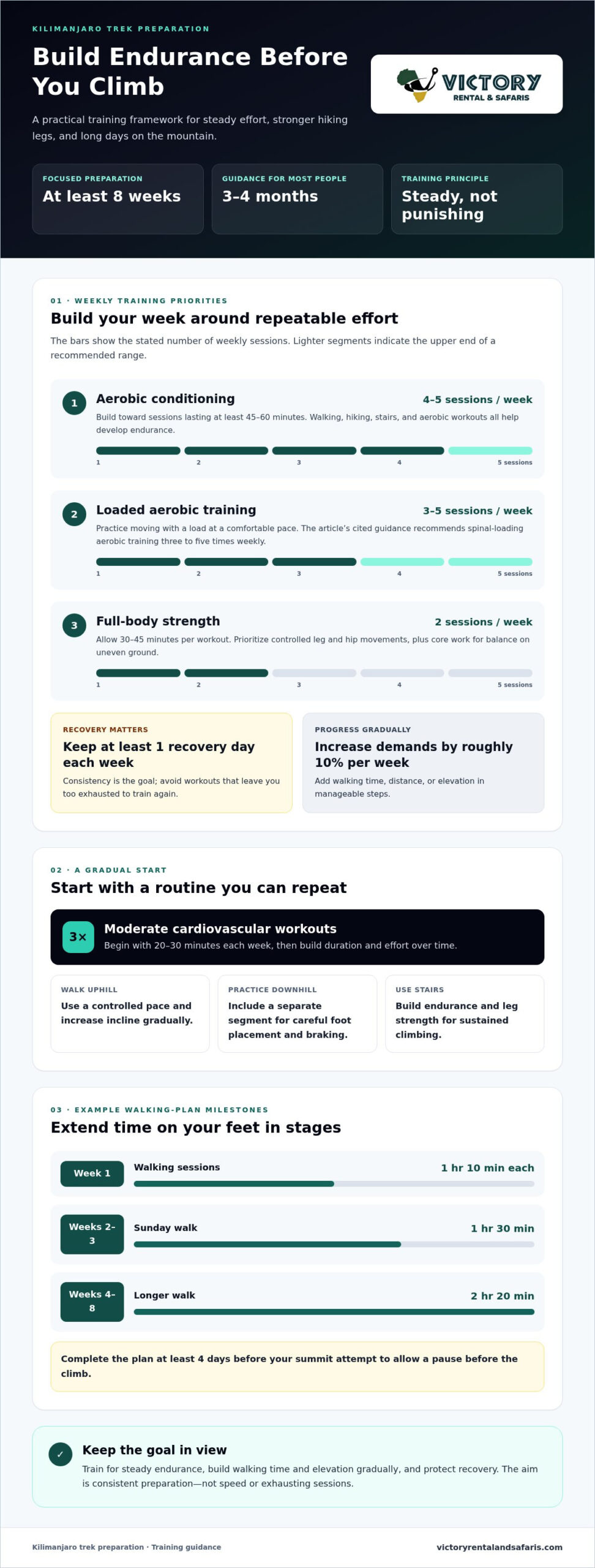
Build the engine for long days on the mountain before focusing on speed. A steady walking pace, stair climbing, and aerobic sessions develop endurance for the ascent. Plan at least eight weeks of focused training before a Kilimanjaro climb. Effective Kilimanjaro trek preparation starts well before departure: Alpine Ascents recommends that most people train specifically for the climb for at least three to four months. As your Kilimanjaro trek preparation progresses, build toward four to five weekly aerobic sessions lasting at least 45–60 minutes.
Begin at a level you can repeat without exhausting yourself. Alpine Ascents recommends starting cardiovascular training with three moderate-intensity workouts of 20–30 minutes per week. Add walking time, distance, or elevation gradually; Alpine Ascents advises increasing these demands by roughly 10% per week. The goal is consistent effort, not a punishing workout that interrupts the next several training days. Keep at least one recovery day per week, as Alpine Ascents recommends.
Use a treadmill when hills or safe outdoor trails aren’t convenient. Walk uphill at a pace that lets you stay in control and keep a steady rhythm, then add a separate downhill segment to practise careful foot placement and braking. Increase the incline gradually instead of jumping straight to a steep setting. Downhill walking uses different movements from climbing, so include it without turning the session into a fast descent. Stair climbing is another useful way to build endurance and leg strength.
Pair aerobic work with strength sessions that support sustained walking. Alpine Ascents recommends two full-body strength workouts per week, each lasting 30–45 minutes. Prioritize controlled movements for the legs and hips, and include core exercises that help you stay balanced on uneven ground. If you’re new to strength training, learn each movement with light resistance before increasing the load. Keep the sessions manageable enough to preserve your regular walking schedule.
Build time on your feet as well as fitness. A simple weekly pattern might combine three moderate aerobic sessions with a longer outdoor walk, then add an uphill treadmill or stair session as your conditioning improves. Alpine Ascents recommends progressing to four or five aerobic sessions weekly, each lasting at least 45–60 minutes. Its guidance also calls for spinal-loading aerobic training three to five times a week. Treat a loaded walk as practice, not a test; comfortable movement matters more than speed.
Use the calendar to guide intensity. The eight-week walking plan gives week-one sessions of 1 hour 10 minutes each, a Sunday walk of 1 hour 30 minutes in weeks two to three, and 2 hours 20 minutes in weeks four to eight. These longer sessions help prepare you for sustained walking, while shorter workouts build a repeatable aerobic base. Finish the plan at least four days before your summit attempt, allowing a pause before the mountain demands your full effort.
Based on the plan referenced in the article, consolidated for quick scanning:
| Week | Weekly pattern | Longest session |
|---|---|---|
| 1–2 | 3 aerobic sessions (20–30 min moderate) + 2 strength workouts | 1 hr 10 min walk |
| 3–4 | 4 aerobic sessions (45–60 min), add hills/stairs + loaded pack (start ~4.5 kg) | 1 hr 30 min hike |
| 5–6 | 4–5 aerobic sessions incl. uphill treadmill at ~300 m/hour pace with pack (7–11 kg); back-to-back hike days once | 2 hr 20 min hike |
| 7 | Peak week — longest back-to-back hikes, full kit rehearsal | 2 hr 20 min + gear test |
| 8 | Taper — halve the volume, finish hard sessions 4 days before departure | 1 hr easy walks |
Readiness check: if you can hike 4–8 hours two days in a row with your day pack, you’re prepared. Finish the plan undertrained but rested, not peaked and exhausted.
Most Kilimanjaro summit treks take 6 to 9 days, depending on route and acclimatization. That span includes the approach, time at camps, summit attempt, and descent; summit night is only one demanding part of the journey. A longer schedule creates room to move steadily and adapt as elevation increases. On Africa’s highest mountain, the route’s daily gains and the time allowed for adjustment shape the experience as much as distance.
On the Barafu Camp route, the trek to Uhuru Peak covers 3 miles and gains 4,265 feet. The steepest section has a grade of 45–50%, making each step more demanding than its distance suggests. The summit stretch averages 8–10 hours of hiking. Climbers then descend, so reaching the top marks a turning point, not the end of the day.
Summit-night timing depends on the route and itinerary. One described approach begins at midnight, aiming to reach the summit by 7 a.m. That schedule means walking through darkness, managing a slow pace, and maintaining warmth while climbing. A member of the trekking group should prepare for sustained effort rather than a short burst. Training for long days helps, but the altitude and steep ascent make summit day distinct from ordinary hikes.
Rest belongs in your plan, too. Finish your last demanding training sessions before travel, then use the days immediately before the climb to recover and sleep well. During the trek, follow the itinerary’s camp schedule instead of treating early progress as a reason to rush. A steady pace preserves energy for summit night, while adequate rest between exertion helps you approach the hardest ascent with more reserves.
The schedule your body is training for:
| Time | What happens |
|---|---|
| ~23:00 | Wake at high camp (Barafu or Kibo), hot drink, layers on, headlamp |
| ~00:00 | Start climbing — slow, steady switchbacks in the dark |
| 06:00–07:00 | Gilman’s Point (5,715 m) → sunrise walk along the crater rim → Uhuru Peak (5,895 m) |
| ~08:00 | Photos, celebration — then immediately descend |
| Midday | Back at high camp: rest, food, water |
| Afternoon | Descend another ~1,300–2,000 m to sleep lower (Mweka or Horombo) |
That’s 12–16 hours of continuous effort at altitude — the reason the training plan above focuses on time on feet, not speed.
Temperatures change sharply between the base and the summit. Base temperatures can reach +20°C, while summit temperatures can reach -15°C at night. Pack layers that let you adjust as the climb moves through changing conditions, and keep warmer items accessible for the coldest hours. The contrast matters: clothing comfortable during a lower-altitude walk may not provide enough warmth during a summit attempt.
This training plan assumes 3–4 months of preparation — which means booking the trek 4–6 months before your target climb date. Guided treks run US$2,000–3,500 per person (our 6-day Rongai starts at US$2,890); see our Kilimanjaro cost guide for the park-fee breakdown. Popular months (February, July–September) fill the best crews first — booking early isn’t just about the discount, it’s about getting the guide-to-climber ratio that keeps summit night safe.
For permits and park rules, the central requirement is that trekkers must be accompanied by a registered and licensed guide, under a regulation introduced in 1991. The exact permit arrangements depend on the trek itinerary, so build them into the guided climb rather than treating the summit as an independent hike.
Visa requirements depend on your nationality and travel circumstances. A travel-health professional can assess vaccinations and medications against your health history and itinerary; choose travel insurance that covers high-altitude hiking up to 6,000 meters.
There is no single best season for every climber; choose travel dates around the weather conditions you prefer and the itinerary available. Temperature varies with elevation, from +20°C at the base to -15°C at the summit at night. For a guided climb shaped around route and summit timing, explore Kilimanjaro climb packages.
For a Kilimanjaro itinerary, aim for at least 8 days on the mountain to allow more time for acclimatization. A 7–8-day climb is recommended, while the shortest itineraries take about 5 days. Those shorter schedules leave less time for gradual adjustment, so compare the route’s length and daily stages before choosing. A longer journey means more time to walk slowly, rest at camp, and respond to the demands of increasing altitude.
Acclimatization is the body’s adjustment to thinner air as elevation rises. Acute altitude sickness can affect people above 2,500 metres, so fitness alone cannot remove altitude risk. Two trekkers on the same route may respond differently, and a comfortable pace for one person may feel strenuous to another. Follow the guides’ pace, pay attention to how you feel, and tell your guide promptly if you feel unwell. Don’t treat symptoms as a reason to push harder.
Itinerary length changes the rhythm of a climb. A five-day route compresses the ascent and camp schedule, while an eight-day plan allows more time for staged progress. Extra days do not eliminate altitude, but they can support a slower approach and provide more opportunities to rest. When comparing routes, look beyond the headline duration: consider how the itinerary distributes elevation gain, where camps fall, and whether acclimatization time is built in.
Use acclimatization hikes as purposeful outings, not extra tests. A recommended approach is to walk for 30 to 45 minutes above camp, then descend to sleep at camp. This lets the day include a higher point without making the sleeping elevation equally high. Keep the pace controlled and follow the route and timing set by your guides. If the itinerary includes these hikes, treat them as part of the climb’s daily effort.
Altitude affects the whole journey, not just summit night. As the trail rises, the same walking effort can feel harder, so moving slowly helps your body adjust. Let your breathing and comfort guide your pace rather than trying to match another trekker. The practical sequence is simple: climb steadily, take planned breaks, complete the acclimatization hike, then return to camp. A longer itinerary makes this pattern easier to follow than rushing between camps.
When selecting among routes, give acclimatization room in your schedule. An itinerary of at least 8 days is a useful planning target, while the exact route determines how the days are arranged. Ask how the trek balances ascent, rest, and acclimatization hikes, then choose a pace you can sustain. On Kilimanjaro, patience is part of the route plan: the goal is not merely to gain altitude, but to give your body time to adapt along the way.
Train for the trail, not just a gym score. Kilimanjaro involves repeated walking, elevation gain, and long days, so practise the movements you’ll use on the mountain. Alpine Ascents recommends becoming comfortable hiking four to eight hours per day. Build toward that duration with outdoor walks, then add hills or stairs to strengthen your legs for sustained climbing. A local one- or two-day hiking trial can help you experience consecutive days on your feet before the trek.
Use a loaded pack gradually. Alpine Ascents recommends starting early-season training hikes with a 10-pound pack and up to 1,000 feet of elevation gain over a 4–6-mile round trip. For successive-day training, Alpine Ascents recommends building the ability to ascend several thousand feet while carrying a 15–25-pound day pack. Increase weight only when your walking remains controlled.
Practise uphill pace as well as distance. Alpine Ascents recommends building the ability to hike uphill at 1,000 vertical feet per hour with the required pack weight. Start with a hill or stair session lasting 20–45 minutes, adjusting duration to your conditioning and how close you are to the trek. Include a recovery day each week. Back-to-back hikes can rehearse consecutive effort; Alpine Ascents suggests a first-day gain of 2,000–3,000 feet roughly a month before the climb.
Choose gear that lets you move naturally. Wear your intended hiking boots and socks on training walks, and test your pack’s fit before adding substantial weight. Trekking poles can help with balance and rhythm on uneven ground, so practise adjusting and placing them on both climbs and descents. Carry the personal items you expect to use, then remove anything unnecessary. Training hikes are the right time to spot rubbing, shifting straps, or awkward pole technique.
On the mountain, expect six to seven hours of hiking per day over multiple days, with summit night requiring 8–10 hours of hiking from Barafu Camp to Uhuru Peak. That makes time on feet as important as speed. Work toward a 10-kilometre hiking day, and practise moving steadily with a loaded pack. Fitness supports the challenge, but a measured pace helps you conserve effort across the full journey.
Daily conditions call for steady habits. Kilimanjaro’s route passes through five climatic zones, so adjust clothing as the environment changes. A practical daypack capacity is 25–35 litres. The recommended daily water intake is 4 to 5 liters; carry a bottle and bladder with a combined capacity of 2–3 litres for the trek. Meals and rest breaks are part of each day’s routine, so eat regularly and keep water accessible while walking.
The best route for climbing Kilimanjaro is the one whose duration and daily effort fit your schedule and fitness. Mount Kilimanjaro rises to 5,895 metres, so route choice affects how quickly you gain elevation and how much time the itinerary allows. Compare days on the mountain, not just the shortest path to the highest point. A longer schedule can leave more room for gradual progress and acclimatization.
Use these route durations as a starting point, then compare how each itinerary distributes its days:
Duration alone doesn’t tell you how physically demanding a trek will feel. Look at daily hiking time, elevation gain, rest opportunities, and the placement of acclimatization hikes. A shorter itinerary compresses the climb into fewer days; a longer one spreads the journey across more time. If your priority is allowing more days for adjustment, compare the 8–9-day Northern Circuit with shorter options. The route details matter as much as its name.
Starting elevation is another practical comparison point. The Shira Route begins at 3,600 metres, so consider that high starting point when weighing its itinerary against other routes. The Northern Circuit offers an 8-day trek, while Lemosho itineraries can last 6 to 8 days. Ask yourself how much time you can dedicate to the mountain and whether the schedule gives you a pace you can sustain. Reaching the summit begins with choosing a plan that suits your available time.
Choose a safe, reputable guide or tour operator by checking that the climb is led by a registered and licensed guide, as required under a regulation introduced in 1991. Then assess whether the itinerary clearly states route, daily stages, acclimatization time, and summit schedule. These details help you understand the physical challenge before committing.
For many trekkers, the clearest takeaway is to favor an itinerary with enough days for a measured ascent, rather than choosing solely for brevity. If the Rongai Route suits your preferred duration and itinerary, compare its 6–7-day schedule with the longer route options. A thoughtful route choice turns Kilimanjaro preparation into a practical plan for the mountain, not just a countdown to summit day.
Explore Kilimanjaro route options and shape your climb around the time and pace that suit your adventure in Tanzania.
After the mountain, Victory Rental & Safaris can help shape the next chapter of your Tanzania journey with a Serengeti Great Migration experience. Turn to the team when you’re ready to trade alpine trails for open plains, wildlife, and the shifting spectacle of the migration. The Great Migration Tanzania Tour and Masai Mara to Serengeti & Ngorongoro Safari Adventure offer other ways to explore the region.
Choose a safari as a distinct extension to your climb, giving the mountain and wilderness their own place in your travel story. If you’re considering a post-trek wildlife journey, contact Victory Rental & Safaris or visit victoryrentalandsafaris.com.
Your summit can be more than the final page of a mountain adventure. Consider what you want the days after climbing to feel like: a slower, wildlife-focused experience, a journey across renowned landscapes, or a change of scene from the mainland. Let that preference guide your wider trip, while keeping your Kilimanjaro trek preparation focused on the climb itself.
Victory Rental & Safaris offers the Serengeti Great Migration, the Masai Mara to Serengeti & Ngorongoro Safari Adventure, and Mikumi Safari from Zanzibar. Each gives travelers a different way to continue exploring Tanzania, whether they’re drawn to migration wildlife, a cross-border safari route, or a safari beginning from Zanzibar. Choose the experience that best matches the kind of story you want to take home.
When you’re ready to consider what comes after the mountain, explore your Tanzania journey with Victory Rental & Safaris. Let the climb be the beginning of a remarkable adventure.
You should be comfortable with prolonged walking and repeated uphill effort, rather than needing to meet an elite-athlete standard. Alpine Ascents says climbers should be comfortable walking four to eight hours per day. A useful readiness check is whether you can complete a long hike, recover, and walk again the following day. If that feels difficult, build consistency before adding steep climbs or a loaded pack.
Most summit treks take 6 to 9 days, depending on the route and acclimatization schedule. That duration covers the approach, summit attempt, and descent, not just the hours spent walking toward Uhuru Peak. Check the itinerary’s start and finish days when arranging your wider trip. The summit attempt is one stage of a multi-day journey, and the route determines how its walking and rest periods are arranged.
Build a repeatable routine that combines aerobic exercise, strength work, and hikes on varied terrain. Alpine Ascents recommends that most people train specifically for the climb for at least 3–4 months. Start with manageable sessions, increase walking time or uphill effort progressively, and practise with the footwear and pack you plan to use. Leave room for recovery, then ease off strenuous training before departure instead of trying to gain fitness at the last minute.
Pack for changing conditions and long days outdoors. Bring broken-in hiking boots, comfortable socks, insulating layers, a waterproof outer layer, gloves, a warm hat, and a headlamp. Your daypack should hold water, snacks, sun protection, personal medication, and spare layers. Practise with trekking poles before departure, especially if you intend to use them on descents. Keep essential documents and frequently used items easy to reach.
Victory Rental & Safaris organizes guided Mount Kilimanjaro trekking packages. Check the details for your chosen itinerary to see which trip components are included, such as guiding, meals, accommodation, transfers, park charges, or equipment. Use the listed inclusions as a planning checklist, then account for the personal items and travel arrangements you’ll organize separately. A package name alone doesn’t describe every component.
No itinerary removes altitude risk, but choosing enough time for gradual ascent and acclimatization is a sensible planning priority. The Northern Circuit offers an 8–9-day trek, while the general recommendation is to spend at least 8 days on the mountain. Compare how each itinerary distributes elevation gain, rest, and acclimatization hikes. A schedule that supports a steady pace is more useful than choosing solely for the fewest days.
There isn’t one daily mileage figure that applies to every Kilimanjaro route. Distance depends on the route, camp locations, and how the itinerary divides the ascent and descent. Even a short distance can feel demanding when the trail climbs steeply or altitude makes walking harder. Review the daily stages rather than relying on a single trip-wide average, and consider elevation gain alongside mileage.
Climbing Mount Kilimanjaro is a sustained physical challenge: the trek combines uneven trails, repeated walking days, and high altitude. You don’t need to be an elite athlete, but you should build endurance and practise long hikes before departure. A consistent preparation routine makes the walking demands more familiar, but it doesn’t remove the separate challenge of adjusting to altitude. Choose an itinerary that fits your available time and hiking experience.
The plan combines aerobic sessions, strength workouts, hills or stairs, progressively loaded hikes, back-to-back hiking days, and a final taper. It builds time on your feet gradually so you can rehearse the effort required for the trek and summit night.
You need enough endurance to hike for 4–8 hours on consecutive days with a day pack. Consistent aerobic training, strength work, loaded walks, and practice on hills or stairs prepare you for the repeated walking and uphill effort of the route.
You typically wake around 23:00, start climbing around midnight, reach Gilman’s Point between 06:00 and 07:00, continue to Uhuru Peak, then descend to high camp and lower sleeping elevations. The full effort can last 12–16 hours at altitude.