
The lake may draw your eye, but its wildlife and living cultures give a Lake Eyasi tour in Tanzania its deeper character. Lake Eyasi lies along the southern boundary of the Ngorongoro Conservation Area, 133 km west of Lake Manyara. Its shallow, salty waters attract hundreds of birds, including flamingos, pelicans and yellow-billed storks, while a visit can also bring you into contact with Hadzabe and Datoga communities.
It’s natural to picture a remote lake and a glimpse of traditional hunting, but a Lake Eyasi tour in Tanzania offers more than either. A Hadzabe tour may include an early-morning walk and an opportunity to observe hunting traditions. Along the lakeshore, changing water levels shape the landscape, while birdlife gives you another reason to pause and look closely during a Lake Eyasi day trip.
This guide explains where Lake Eyasi is, what a Hadzabe visit involves, and which cultural encounters and wildlife you may experience. You’ll also find practical context for the early start and how the lake’s surroundings fit into a northern Tanzania journey, helping you picture the day beyond its first striking view.
At Lake Eyasi, a Hadzabe tour can bring you closer to Hadzabe traditions and the rhythms of a hunter-gatherer day. Early outings may include a walk with Hadza hunters, while meeting Datoga people offers another perspective on communities living in this part of northern Tanzania.
The Hadzabe language is a distinctive spoken tradition, with click sounds similar to those in San languages of Southern Africa. Hearing it in conversation can help you appreciate how language carries cultural knowledge beyond what a guide can translate. Activities may include meeting community members and observing everyday skills, making the visit more than a brief introduction to hunting.
A Hadzabe visit may include accompanying hunters as they search for wild food using traditional bows and arrows. The outing often begins before dawn: tours may depart between 0400 Hours and 0500 Hours to reach the community for morning hunting. Visitors can observe the hunters’ knowledge of the bush and, on some visits, go on a Hadzabe hunting trip with them.
The Hadza around Lake Eyasi are nomadic hunter-gatherers whose food gathering and hunting are closely connected to the surrounding landscape. One account reports that they collect 95 % of their diet from wild foods. Their way of life offers a window into practical knowledge of local plants, animals, and terrain, rather than a staged safari display.
Community visits also provide context for the people who call the Lake Eyasi area home. The Hadzabe, Datoga, and Mbulu live in the region; the Datoga and Mbulu are pastoralists, like the Maasai. Fewer than 100 Hadza individuals live in the area around the lake, making considerate, attentive visits especially important.
Birding can complement the cultural experience. Lake Eyasi’s salty, shallow waters attract hundreds of birds, including flamingos, pelicans, and yellow-billed storks. If you’re interested in both wildlife and culture, take time to notice how the changing lakeshore, open bush, and community encounters each offer a different perspective on northern Tanzania.
Approach the visit as an exchange, not a performance. Listen to your guide and hosts, let conversations and demonstrations unfold at their own pace, and treat hunting as a traditional skill rather than a spectacle. This approach makes the morning’s cultural details, from spoken language to bow-and-arrow techniques, easier to understand and remember.
Lake Eyasi lies in northern Tanzania, 133 km west of Lake Manyara, along the southern edge of the Ngorongoro Conservation Area. Compared with Ngorongoro Crater and Lake Manyara tours, a Lake Eyasi itinerary brings cultural visits and lakeshore time into the safari, alongside wildlife viewing.
Mang’ola is the main settlement in the Lake Eyasi area and a base for visiting Hadza families. Karatu, about an hour’s drive away, is another practical place to stay overnight. Choose based on whether you want to be closer to the lake or use Karatu as a staging point. Arusha is about a four-hour drive from Lake Eyasi.
The lake sits at the base of the Rift Valley Escarpment, giving the drive a different feel from a route focused only on crater landscapes. Water levels shift between rainy and dry seasons, so the lakeshore can look substantially different at different times of year. A stop by the water is therefore a distinct part of the itinerary, not a fixed wildlife-viewing experience.
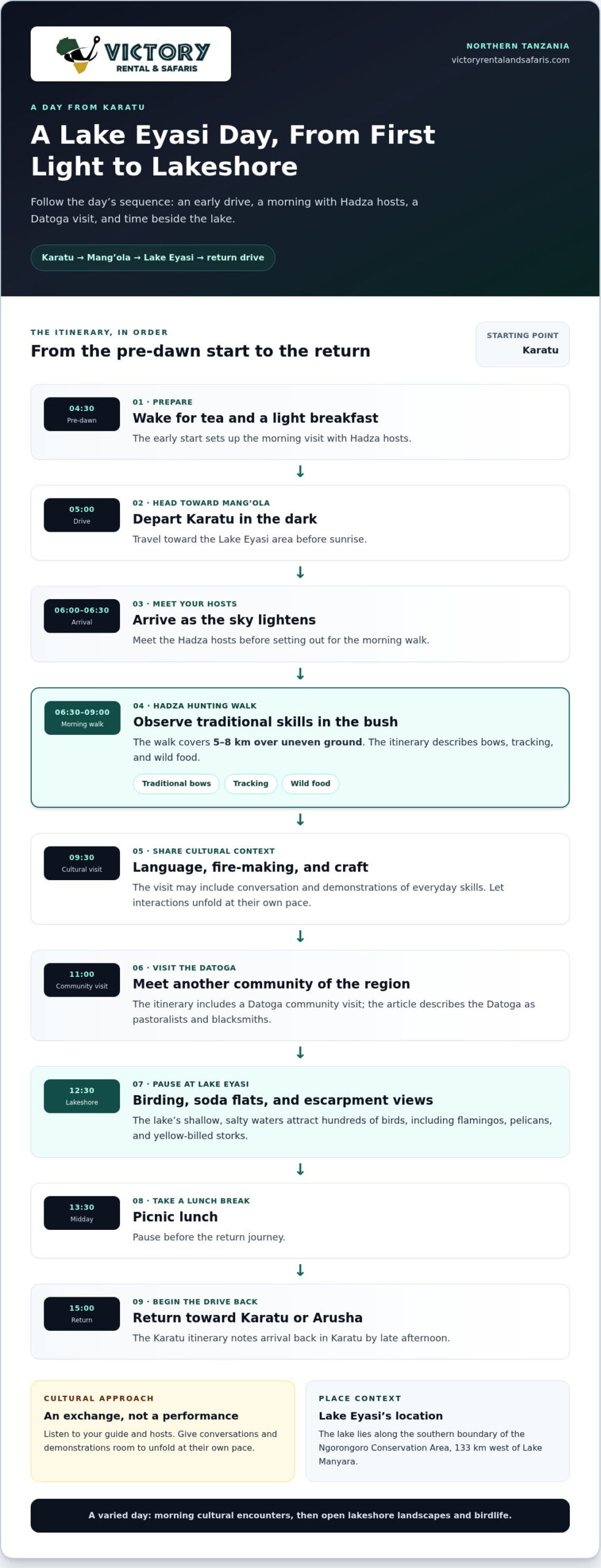
A day visit often starts before sunrise to reach the Hadzabe for morning hunting. One itinerary schedules the hunt for 0630 Hours, followed by cultural interaction at 0930 Hours. The early start shapes the rest of the day: it leaves room for a Datoga visit and a stop at the lake before the return journey.
The same outline places a Datoga visit at 1100 Hours and a visit to Lake Eyasi’s shores at 1230 Hours. Lunch and the return drive are scheduled for 1330 Hours, with the drive back to Karatu or Arusha starting at 1500 Hours. These stops create a varied day, moving from community encounters to the lake’s open landscape.
| Time | What happens |
|---|---|
| 04:30 | Wake; tea and a light breakfast |
| 05:00 | Depart Karatu toward Mang’ola in the dark |
| 06:00–06:30 | Arrive; meet your Hadza hosts as the sky lightens |
| 06:30–09:00 | Morning hunting walk (5–8 km over uneven ground; bows, tracking, wild food) |
| 09:30 | Cultural interaction — language, fire-making, craft |
| 11:00 | Datoga community visit (pastoralist blacksmiths) |
| 12:30 | Lakeshore stop — birding, soda flats, escarpment views |
| 13:30 | Picnic lunch |
| 15:00 | Return drive; back in Karatu by late afternoon |
For northern Tanzania safari planning, Lake Eyasi can complement an Ngorongoro family safari, Lake Manyara, and Tarangire. The lake is about 40 miles from Ngorongoro Crater, 53 miles from Lake Manyara National Park, and 70 miles from Tarangire National Park. A route can therefore pair cultural experiences with wildlife areas without treating them as interchangeable stops.
Shape the itinerary around your priorities. A dawn departure makes room for the morning visit, while a lakeshore stop adds time for scenery and birding. If your route starts in Arusha, allow for the four-hour drive to Lake Eyasi. Starting from Karatu shortens the approach to about an hour. For wider planning, see our Tanzania safari guide and information on Tanzania park fees for 2026.
Changing water levels also matter when planning a Lake Eyasi safari itinerary. April and May bring the long rains and are considered questionable months for visiting, although the lake can be visited year-round. Account for seasonal conditions when planning the route and lakeside stop, especially if you’re combining the lake with crater or Manyara visits.
Lake Eyasi occupies the southern edge of Tanzania’s Ngorongoro Conservation Area, beneath the Rift Valley Escarpment. This setting places it in a striking transition between highland slopes, open bush, and the lake basin. It lies 133 km west of Lake Manyara, but its scenery differs: Eyasi is a shallow soda lake, not a crater or a conventional freshwater lake.
At about 1,050 square km, the lake is larger than Lake Manyara. Its size can be deceptive, however, because its visible water changes substantially with the seasons. During the dry season, the lake can become virtually nonexistent; in the rainy season, it may hold deep water. The shoreline you encounter therefore depends on recent rainfall and the time of year.
Karatu is a useful starting point for reaching the lake, while Arusha works as a base for a broader northern Tanzania journey. Lake Eyasi is about an hour’s drive from Karatu and about four hours from Arusha. For a dawn visit, an overnight stay near the lake or in Karatu can make the early departure more comfortable than setting out from farther away.
Distances also help show how Eyasi fits into a regional route. Ngorongoro Crater is 40 miles away, Lake Manyara National Park is 53 miles away, and Tarangire National Park is 70 miles away. Serengeti National Park is listed 88 miles from the lake. These nearby destinations make it possible to consider cultural encounters and varied landscapes within one northern safari itinerary.
Arusha lies 113 miles from Lake Eyasi, while Karatu is 46 miles away. The distinction between road distance and travel time is useful: route conditions and the chosen starting point shape how the journey feels. A visit based around Karatu places the lake closer to the day’s central experience; an Arusha departure makes Eyasi part of a longer regional drive.
Lake Eyasi’s geography helps explain why it feels different from a wildlife reserve. Its changing waterline, escarpment backdrop, and open surroundings create a landscape shaped by both season and location. Near Ngorongoro and Lake Manyara, it makes a distinct addition to an itinerary rather than a substitute for either destination.
For a Serengeti-focused itinerary, consider the direction of travel before adding Eyasi. The lake sits south of the wider northern circuit, while Serengeti is listed 88 miles away. Pairing these areas means balancing the cultural and lakeside character of Eyasi with the wider safari route, rather than treating every stop as a short detour.
Before choosing a starting point, match the route to your priorities. Karatu offers a shorter approach to the lake, while Arusha connects Lake Eyasi with a broader northern Tanzania journey. Season matters too: variable water levels can change the lakeshore, so timing and geography together shape the experience.
A Lake Eyasi tour in Tanzania can combine community visits, a morning walk, and time around the lake. The overall cost depends on the itinerary, transport, accommodation, and included activities. The lake is visitable year-round, though April and May bring long rains, and changing water levels can influence the day’s plans.
A Hadzabe visit is an early outing to meet community members and observe traditional skills. Visitors should plan to wake around 5 or 5:30 a.m. for a morning hunt. Walks with Hadzabe people cover 5 to 8 km, so comfortable footwear and readiness for uneven terrain help you enjoy the walk.
Some outings allow an hour or two for hunting and food gathering. Observe how hunters use traditional bows and arrows, and listen as local knowledge guides the activity. This is not a performance on a fixed schedule: the route and pace depend on the surrounding bush and the hunters’ decisions. Attentive observation is more useful than expecting a particular result.
Meeting the Hadzabe and Datoga on the same day offers two distinct cultural encounters. An early start makes room for both: the Hadzabe visit focuses on hunter-gatherer life, while the Datoga visit offers a perspective on pastoral traditions. The contrast helps you understand how communities relate differently to the Lake Eyasi landscape.
Travel time affects how the day is arranged. One tour description allows about two hours to reach the Hadzabe from the departure area along a rough trail. The drive from Lake Eyasi to a Hadzabe village takes another 30 minutes. These approaches help explain why fitting both visits into one day calls for an early departure and a considered itinerary.
The lake eyasi cost varies with the route, transport, accommodation, and activities. A focused cultural visit differs from a longer safari combining Lake Eyasi with other destinations. Compare what each itinerary includes, rather than treating every visit as the same experience.
Lake Eyasi tours are typically priced per vehicle or per person depending on group size. As a 2026 guide (confirm current rates — they vary by group size and season):
| Item | Typical range (USD) |
|---|---|
| Day trip from Karatu (per person, joining a small group) | US$80–150 |
| Private day trip (per vehicle, up to 4–6 guests) | US$250–400 |
| Overnight near the lake / Karatu (double, B&B) | US$80–180 |
| Community visit fees | Usually included in the tour price — confirm when booking |
Starting from Arusha instead of Karatu adds roughly 3 hours of driving each way, so most travelers sleep one night in Karatu before the dawn start — it turns a grueling day into an easy one.
Lake Eyasi can be visited throughout the year, while April and May bring the long rains. Seasonal changes in water levels can affect the lakeshore’s appearance and how the visit is planned. A morning community visit and a lakeside stop offer different experiences, so the season helps determine how to balance them in your itinerary.
Lake Eyasi can be visited throughout the year. April and May bring the long rains, which can affect road conditions, the lakeshore, and the feel of the day. During the dry season, the lake may become virtually nonexistent, while the rainy season can bring deeper water. Choose your timing based on whether you want to focus more on the morning cultural visit, birding, or the changing lakeside landscape.
Lake Eyasi’s wildlife story begins at the water’s edge, where shallow, salty conditions attract hundreds of birds. Birding here offers a different focus from the large-mammal viewing associated with Tanzania’s better-known safari parks. Part of the Great Rift Valley landscape, the lake has a changing shoreline that offers a vivid setting for observing birds and seeing how water shapes the region.
Flamingos, pelicans, and yellow-billed storks are among the birds recorded around Lake Eyasi. A lakeside stop can reward travelers who enjoy identifying birds as well as taking in the scenery. Move slowly along the shore, scan open water and nearby shallows, and give each sighting time. Rather than trying to tick off a long checklist, take in the lake’s distinctive birdlife.
Water levels vary substantially between rainy and dry seasons, changing the amount of visible water and the character of the shoreline. In the dry season, the lake can become virtually nonexistent; in the rainy season, it can become quite deep. This contrast matters for wildlife watchers: the lake’s appearance is not fixed, and a visit at a different time of year may reveal a very different waterside landscape.
Lake Eyasi also supports fish, including catfish and lungfish. These species add an aquatic dimension to a visit centered on birds, culture, and the wider Rift Valley. The lake’s wildlife reflects its distinctive waterside landscape, so focus on the encounters available there rather than expecting a particular safari experience.
Plan the lakeshore stop around observation, not speed. Notice the contrast between open water, exposed shore, and surrounding bush, then look for the flamingos, pelicans, and yellow-billed storks known from the area. Birding can complement cultural activities with the Hadzabe, sometimes called bushmen, but the experiences are separate. Each reveals a different relationship with the Lake Eyasi environment.
The clearest takeaway is that Lake Eyasi is especially compelling for birdlife and landscape, with fish adding another layer to its wildlife. It isn’t a substitute for a classic big-game safari; its appeal lies in the combination of a changing soda lake, distinctive birds, and cultural encounters nearby. For a visit that balances these Lake Eyasi wildlife and cultural experiences, shape the day around both the lakeshore and the surrounding communities.
When you’re ready to move from Lake Eyasi’s cultural encounters to the Serengeti’s wildlife, Victory Rental & Safaris can help shape the next part of your Tanzania journey. Its Serengeti Great Migration and Great Migration Tanzania Tour offerings suit travelers drawn to the scale and movement of the migration. The Masai Mara to Serengeti & Ngorongoro Safari Adventure connects destinations across a wider safari route.
Choose the experience that best matches the landscapes and wildlife you want to prioritize. For a Tanzania itinerary that continues beyond Lake Eyasi, contact Victory Rental & Safaris to discuss your plans.
Your Lake Eyasi tour in Tanzania can be one chapter in a broader journey, with the next destination chosen around the experience you want to carry forward. You might choose the Serengeti Great Migration, connect landscapes through the Masai Mara to Serengeti & Ngorongoro Safari Adventure, consider the Mikumi Safari from Zanzibar, or continue with a Zanzibar honeymoon. Each offers a different way to continue your travels.
Let your priorities guide the next step: migration-focused wildlife, a route linking renowned safari regions, or a journey that begins from Zanzibar. Victory Rental & Safaris can help you explore these experiences and choose how one fits your plans.
Contact Victory Rental & Safaris to discuss your Tanzania journey and take the next step toward an experience shaped around what inspires you.
Expect cultural encounters, open landscapes, and wildlife observation, rather than a day focused only on big game. A visit may bring together Hadzabe traditions, a Datoga community encounter, and time to watch birds near the lake. Water levels change the character of the lakeshore, so the scenery varies by season. Leave room for both planned visits and unhurried observation.
Lake Eyasi is in northern Tanzania, west of Lake Manyara and beside the Ngorongoro Conservation Area. Travelers commonly approach by road from Karatu or Arusha, and the starting point shapes the length and rhythm of the journey. The drive takes about four hours from Arusha and about an hour from Karatu. For a dawn community visit, an overnight stop near the route can help you avoid a very early departure from farther away.
Package arrangements vary with the itinerary. A culture-focused outing may center on a Hadzabe visit, while a broader plan can combine community encounters with lakeside birding and other northern Tanzania destinations. Transport and the order of stops also shape the day. Before choosing, decide whether your priority is cultural exchange, time by the water, or including Lake Eyasi in a wider safari route.
The drive takes about four hours from Arusha and about an hour from Karatu, but those are travel times, not the full tour duration. A visit that includes an early Hadzabe encounter, a Datoga stop, and time by the lake can occupy much of the day. Starting from Karatu shortens the approach, while an Arusha departure means more time on the road before activities begin.
Yes, visits to both communities can be arranged in the Lake Eyasi area, and an early start can make same-day encounters possible. The Hadzabe are hunter-gatherers, while the Datoga are pastoralists, so each meeting offers a different view of local knowledge and daily life. Treat each visit as a respectful exchange: listen to your hosts, follow your guide’s lead, and let the encounter unfold at its own pace.
Activities can include meeting Hadzabe community members, observing traditional hunting, visiting the Datoga, walking in the surrounding landscape, and birdwatching at the lake. Flamingos, pelicans, and yellow-billed storks are among the birds associated with the area. The combination depends on the itinerary and shoreline conditions. If birding matters to you, allow time to pause and scan the lake rather than rushing between stops.
Follow your guide’s directions and respect the wishes of the people you visit. Ask before taking photographs, avoid interrupting demonstrations or conversations, and don’t treat traditional hunting as a staged performance. Arrange access to community visits through your tour itinerary rather than assuming you can enter independently. These courtesies help keep encounters considerate and let hosts decide how they wish to share their culture.
Plan for a remote outdoor setting: follow your guide’s instructions, stay with your group, and take care on uneven trails. Bring any personal medication you rely on, protect yourself from sun exposure, and carry drinking water for the outing. For health advice tailored to your itinerary and medical needs, speak with a qualified travel health professional before departure.
Wear comfortable footwear and clothing suited to an early outdoor walk over uneven terrain. The morning walk can cover 5 to 8 km, so choose practical clothing that lets you move easily.
A dawn itinerary typically begins with waking around 04:30 and departing Karatu at 05:00 to reach the Hadza hosts as the sky lightens.
Yes. Lake Eyasi can complement a visit to Ngorongoro Crater within a wider northern Tanzania itinerary, with the route arranged around the early Hadzabe visit and other safari stops.
Yes. Starting from Karatu makes a one-day visit practical, with time for a morning hunting walk, cultural interaction, a Datoga community visit, a lakeshore stop, lunch, and the return drive by late afternoon.