
Ten days is the sweet spot for a Tanzania Northern Circuit safari. It is long enough to give Tarangire, Ngorongoro Crater and the Serengeti each a real day, without turning every morning into a transfer. A well-paced 10-day itinerary runs roughly US$3,500–6,000 per person on a mid-range package, and the park fees alone add up to about US$450–550 per person on this route. This guide gives you a working day-by-day plan, the real 2026 park fees for each stop, and a checklist of what your safari package should include, so you can judge any quote on facts, not promises. Confirm current tariffs with your operator before booking, as TANAPA and NCAA adjust fees each year.
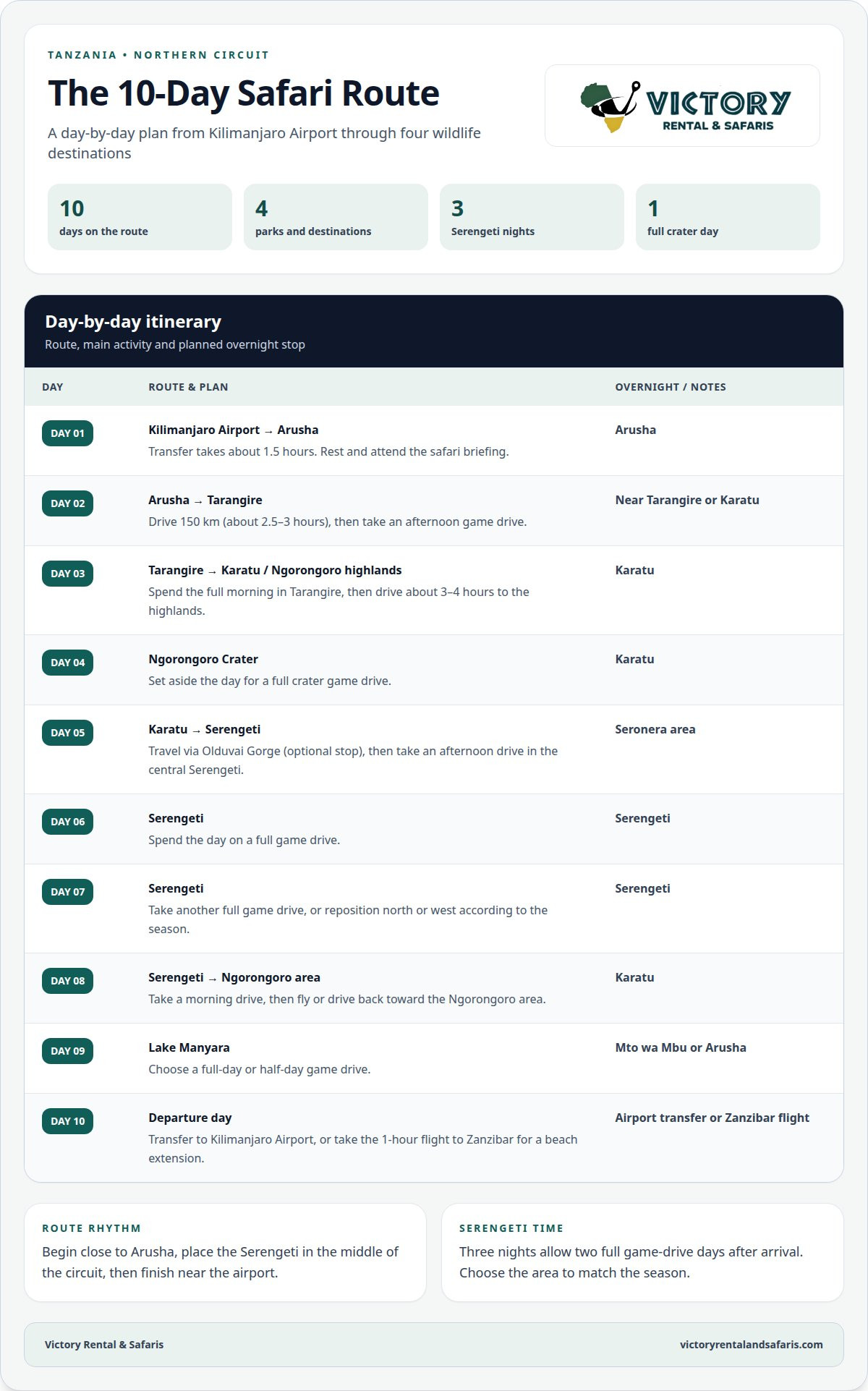
| Day | Plan |
|---|---|
| Day 1 | Arrive Kilimanjaro Airport → Arusha (1.5h transfer). Rest, briefing, overnight Arusha. |
| Day 2 | Arusha → Tarangire (150 km, 2.5–3h). Afternoon game drive. Overnight near Tarangire or Karatu. |
| Day 3 | Full morning in Tarangire → drive to Karatu / Ngorongoro highlands (3–4h). Overnight Karatu. |
| Day 4 | Full-day Ngorongoro Crater game drive. Overnight Karatu. |
| Day 5 | Karatu → Serengeti via Olduvai Gorge (optional stop). Afternoon drive in central Serengeti. Overnight Seronera area. |
| Day 6 | Full Serengeti game drive. Overnight Serengeti. |
| Day 7 | Full Serengeti game drive (or reposition north/west by season). Overnight Serengeti. |
| Day 8 | Morning drive → fly or drive back toward Ngorongoro area. Overnight Karatu. |
| Day 9 | Lake Manyara full-day or half-day drive. Overnight Mto wa Mbu or Arusha. |
| Day 10 | Transfer to Kilimanjaro Airport for departure, or take the 1-hour flight to Zanzibar for a beach extension. |
This order follows the geography: it starts closest to Arusha, saves the biggest park for the middle, and ends near the airport so day 10 is a short transfer instead of an eight-hour drive.
Ngorongoro is a conservation area, not a standard national park, and it deserves a full crater day rather than a quick stop between transfers. The crater floor spans about 20 kilometres, its walls rise roughly 600 metres, and it holds an estimated 25,000 large animals. These include a resident population of black rhinos that makes this one of the best places in East Africa to spot one.
Plan the days around the crater in this order:
Plan your crater day from Karatu or a highlands lodge, and keep it separate from the drive in. The road from Tarangire to the Ngorongoro area takes about 3–4 hours excluding game viewing, so don’t try to combine that transfer with the crater floor. Do the transfer on day 3, sleep near the rim, and descend early on day 4 when the wildlife is most active and the light is best.
If Olduvai Gorge interests you, slot it between Karatu and the Serengeti on day 5, since it sits on that road, rather than cramming it into crater day. One full day on the floor, guided by your driver’s live sightings, beats a checklist of rushed stops.
For more on the crater itself, see our Ngorongoro Crater destination guide.
Set aside three nights in the Serengeti. That gives you two full game-drive days after arrival, which is the minimum for a park of nearly 15,000 square kilometres. Where you base yourself should follow the calendar, not habit:
For park background and landscapes, see our Serengeti National Park destination guide. If migration timing drives your plans, the Serengeti migration month-by-month guide goes deeper.
Tarangire is the natural first park: 150 kilometres from Arusha, a 2.5–3 hour drive, and a completely different character from the rest of the circuit. Treat the afternoon as a real game drive rather than a drive-through.
Leave Arusha by 7 AM and enter the park around 10 AM. Tarangire opens at 6 AM, so an early start protects your morning hours and your game-drive time.
Plan a dedicated game drive after entering the park. Follow sightings and route conditions with your guide, and allow time to pause and observe. Coordinate the drive’s finish with your lodge and the next day’s journey.
The park’s signature is elephants. In the dry season (June–October), Tarangire’s herds can number in the thousands along the Tarangire River, the largest elephant gatherings in northern Tanzania. They move alongside baobab-dotted plains that photograph better than almost anywhere on the circuit. Green season (November–March) is quieter and cheaper, with more dispersal but still strong birding.
Families planning this stop can also read our Tarangire family safari lodge guide.
Use Arusha as the arrival and departure anchor for your Northern Circuit route. Plan around your landing time, first park transfer, and final flight rather than squeezing travel into game-drive hours.
Schedule arrival in Arusha for day one, leaving the rest of that day for settling in and preparing for the safari. Kilimanjaro International Airport is the main air gateway for this route, and the transfer to Arusha takes about 1.5 hours. Avoid a long park drive right after an international flight. Use the first night to rest, attend your briefing, and organize the morning’s departure.
Use Arusha as your starting point for the northern parks, then order the route to reduce backtracking. Tarangire is about 150 kilometres away, a drive of roughly 2.5 to 3 hours. Starting there lets you continue toward Ngorongoro and the Serengeti, with Lake Manyara added late in the route.
Set your departure transfer around your last overnight stay and your international flight time. Allow enough time for the road transfer from Arusha to Kilimanjaro International Airport. If your route ends near Mto wa Mbu, plan for a substantial drive to Arusha before continuing to the airport.
For this exact 10-day route, the 2026 park fees per adult work out to roughly US$450–550 per person. For the full tables, use the official tariff pages from Tanzania National Parks and the Ngorongoro Conservation Area Authority, or read our Tanzania national park fees guide.
We run Northern Circuit safaris from our Arusha office, with scheduled departures through 2026 and private itineraries on request. Every quote is itemized, with park fees, lodges, vehicle and guide shown line by line. Trek documents arrive no later than seven days before departure. Tell us your travel month and we’ll match your Serengeti days to the migration and send a written quote you can compare against any other offer.
If the Great Migration is central to your plans, Victory Rental & Safaris offers the Serengeti Great Migration and the Great Migration Tanzania Tour. The Masai Mara to Serengeti & Ngorongoro Safari Adventure links celebrated wildlife destinations in one journey.
The best 10-day itinerary is the one built around what you want to remember — elephants under baobabs, a crater floor at first light, or a river crossing in the northern Serengeti. Send us your travel month and the parks that matter most, and we’ll send back a written day-by-day route with real prices and every inclusion listed, so you can compare it honestly against any other quote.
For a broader wildlife journey, Victory Rental & Safaris offers the Serengeti Great Migration and the Masai Mara to Serengeti & Ngorongoro Safari Adventure. If you’re beginning in Zanzibar, the Mikumi Safari from Zanzibar offers another way to bring wildlife into your trip.
Contact Victory Rental & Safaris today to discuss your safari plans. Tanzania’s wild landscapes are waiting to become part of your story.
Budget US$3,500–6,000 per person for a mid-range package, plus roughly US$450–550 per person in park fees. Most good packages fold the fees into the daily rate. Confirm current TANAPA and NCAA tariffs for your dates before booking.
The classic circuit is Tarangire, Lake Manyara, Ngorongoro Crater and the Serengeti, starting and ending in Arusha. Ten days covers all four comfortably. Seven days means dropping one park, usually Lake Manyara, or shortening the Serengeti.
June–October is the dry season, with the best general wildlife viewing and the Tarangire elephant gatherings. January–March is calving season in the southern Serengeti. August–October is the Mara River crossing season. April–May is green, quiet and cheapest, with some lodges closed.
Driving is the norm and part of the experience. The one flight worth considering is Serengeti to Arusha on day 8–10, which saves an eight-hour drive. Bush flights limit luggage to 15 kg per person in soft bags. Most 10-day itineraries are fully overland with no flights needed.
Yes. The flight from Arusha or the Serengeti airstrips to Zanzibar takes about an hour. Schedule it after your final park day, not mid-safari, and allow a buffer between your last game drive and the flight. Our Zanzibar beach and safari combo guide covers combined itineraries.
Once your ten safari days are set, you can keep the journey going. Victory Rental & Safaris offers the Mikumi Safari from Zanzibar and the Zanzibar Beach & Safari Combo for travelers who want island time after the circuit. Explore the Zanzibar holiday options, then contact Victory Rental & Safaris to start planning.
{
“@context”: “https://schema.org”,
“@type”: “FAQPage”,
“mainEntity”: [
{“@type”: “Question”,”name”: “How much does a 10-day Northern Circuit safari cost in 2026?”,”acceptedAnswer”: {“@type”: “Answer”,”text”: “Budget US$3,500–6,000 per person for a mid-range package, plus roughly US$450–550 per person in park fees. Most good packages fold the fees into the daily rate. Luxury lodge versions run US$6,000–10,000+. Confirm current TANAPA and NCAA tariffs for your dates before booking.”}},
{“@type”: “Question”,”name”: “Which parks are on the Northern Circuit?”,”acceptedAnswer”: {“@type”: “Answer”,”text”: “The classic circuit is Tarangire, Lake Manyara, Ngorongoro Crater and the Serengeti, starting and ending in Arusha. Ten days covers all four comfortably. Seven days means dropping one park, usually Lake Manyara, or shortening the Serengeti.”}},
{“@type”: “Question”,”name”: “When is the best time for a Northern Circuit safari?”,”acceptedAnswer”: {“@type”: “Answer”,”text”: “June–October is the dry season, with the best general wildlife viewing and the Tarangire elephant gatherings. January–March is calving season in the southern Serengeti. August–October is the Mara River crossing season. April–May is green, quiet and cheapest, with some lodges closed.”}},
{“@type”: “Question”,”name”: “Should I fly between parks or drive?”,”acceptedAnswer”: {“@type”: “Answer”,”text”: “Driving is the norm and part of the experience. The one flight worth considering is Serengeti to Arusha on day 8–10, which saves an eight-hour drive. Bush flights limit luggage to 15 kg per person in soft bags. Most 10-day itineraries are fully overland with no flights needed.”}},
{“@type”: “Question”,”name”: “Can I add Zanzibar to the same trip?”,”acceptedAnswer”: {“@type”: “Answer”,”text”: “Yes. The flight from Arusha or the Serengeti airstrips to Zanzibar takes about an hour. Schedule it after your final park day, not mid-safari, and allow a buffer between your last game drive and the flight.”}}
]
}