
What if the best Serengeti Great Migration safari isn’t the one with a river crossing? The herds move in response to rain and fresh grazing, and even during the famous Mara River season, a crossing can’t be scheduled or guaranteed. It’s natural to hope for that heart-stopping moment, but the migration is a changing spectacle, not a timed performance.
That uncertainty makes choosing a travel season and setting realistic expectations especially important. The migration moves through different parts of the Serengeti over the year, bringing changing landscapes and wildlife encounters, from calving season in the south to possible river crossings in the north.
This guide explains the seasonal cycle, what you might experience at different times, and how a migration-focused safari differs from a general Serengeti trip. You’ll also find a practical way to shape your plans with Victory Rental & Safaris, whether you’re considering the Serengeti Great Migration or the Great Migration Tanzania tour. Plan for the living spectacle, and leave room for each day’s discoveries.
Across the Serengeti, the horizon can seem to ripple with moving wildebeest, while zebra and gazelles travel through the same broad landscape. Their presence gives the plains a sense of motion and scale that’s difficult to capture in a single photograph. Yet the Great Migration isn’t one procession passing a fixed viewpoint. It’s the recurring movement of wildlife through the Serengeti ecosystem as conditions change.
In brief: The Great Migration is the seasonal movement of herds through the Serengeti ecosystem, not a single scheduled river crossing. That distinction matters when planning a Serengeti Great Migration safari. The journey is about experiencing a living natural pattern, not booking a guaranteed scene. For broader context on the park’s geography and wildlife, see the Serengeti National Park Wikipedia page.
Large herds move through changing landscapes in response to seasonal conditions. Wildebeest are at the heart of the spectacle, with zebra and other grazing animals also part of the wider movement. The herds cross open plains and other habitats within the ecosystem, so the setting and character of a wildlife-viewing day can change with the season and location.
This isn’t a parade in which every animal arrives together or follows a visitor’s timetable. Herds may spread out, gather in particular areas, or move on, while other wildlife remains part of the surrounding landscape. A trip focused on the migration can bring you closer to this shifting story, but no itinerary means seeing every species or every phase. The natural world sets the pace.
A general wildlife safari can focus on a broad range of animals and landscapes. A migration-focused safari adds a particular thread of anticipation: following the herds and noticing how their presence changes the plains around them. Instead of treating each drive as a checklist, you can look for signs of the wider seasonal story, from grazing groups on open grassland to the wildlife sharing their habitat.
The appeal lies in the chance to witness natural behavior in an immense, open setting. A herd stretching across the distance, animals pausing to feed, or a sudden shift of movement across the plain can make an ordinary-looking moment feel extraordinary. Some days may bring close encounters; others may reward patience with a quieter view of the ecosystem at work. Both are part of the experience.
Choose this kind of journey if the changing movement of wildlife is part of what draws you to Tanzania, and if you’re comfortable letting the landscape shape each day’s discoveries. The memorable story might be a dramatic gathering or a succession of smaller moments that reveal how life across the Serengeti is connected.
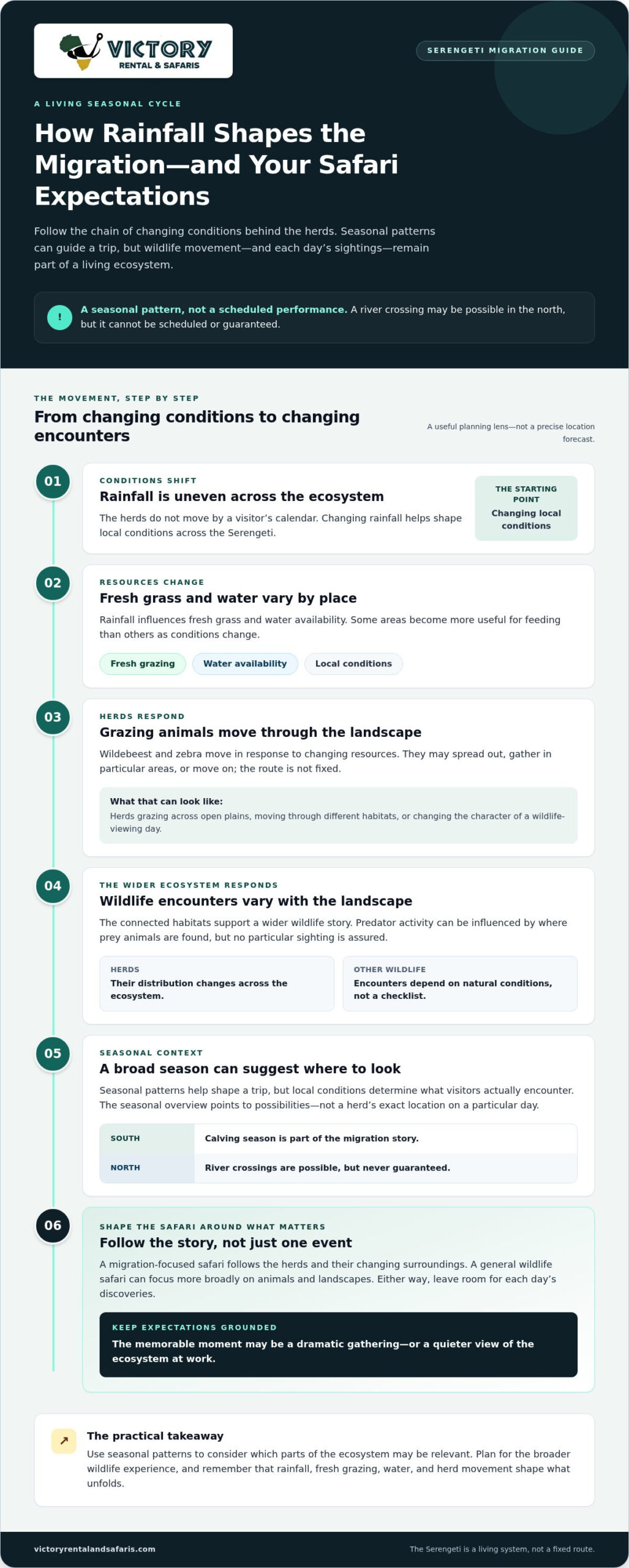
The herds don’t move according to a visitor’s calendar. Their routes respond to changing conditions across a broad landscape, where rainfall affects the growth of fresh grass and the availability of water. Those changes influence where wildebeest and zebra can feed, but no single factor explains every turn or pause in their journey.
Migration locations can shift because rainfall is uneven across the ecosystem, grass and water change with local conditions, and herds respond to those changing resources at different times. A seasonal overview can help you shape a trip, but it can’t pinpoint where wildlife will be on a particular day. The Serengeti is a living system, not a fixed route.
Fresh grass is essential for grazing animals, and water matters too. As seasons change, some areas offer better feeding than others, so herds move through the landscape rather than remaining in one place. Rainfall patterns help shape this cycle, but the animals’ movement reflects a combination of conditions, not a simple switch from one destination to another.
For safari planning, the broad season can suggest which parts of the ecosystem may be relevant, while local conditions influence what visitors actually encounter. A Serengeti Great Migration safari is shaped around movement and possibility, not a promise that a herd will be at a specific point on a given morning.
Serengeti National Park is part of a larger, connected ecosystem of feeding grounds and wildlife habitats. Animals move through different landscapes within this wider region, and their presence affects other species. Predators rely on prey animals for food, so the changing distribution of herds can influence where predator activity occurs. That relationship is part of the natural story, though it doesn’t guarantee a particular sighting.
The Mara River is one possible feature of the migration story, especially when herds reach the northern part of their range. It isn’t the whole journey. Feeding, movement across open country, and the changing relationship between wildlife and habitat matter throughout the cycle. For additional context on how changes to habitat can affect migratory wildlife, explore Dartmouth research on wildebeest migration vulnerability.
Thinking in terms of a connected ecosystem helps set useful expectations. Rather than focusing only on a famous landmark or dramatic moment, consider how your travel window aligns with the season and which landscapes you hope to explore. Victory Rental & Safaris offers guided Serengeti Great Migration safaris for travelers drawn to this remarkable, ever-changing wildlife journey.
The herds follow the rains, so the calendar below is the reliable starting point for choosing your season — then let your guide adjust to where the grass actually is when you arrive.
| Months | Where the herds are | What you’ll experience |
|---|---|---|
| January – March | Southern Serengeti & Ndutu plains | Calving season. Around half a million wildebeest calves are born in a few weeks, and the predator action that follows is the most intense of the year. Green, lush, far fewer vehicles than peak season. |
| April – May | Western corridor (Grumeti region) | The herds mass along the Grumeti River — smaller, quieter crossings than the Mara, excellent value as this is low season. Some camps close in April; long rains possible. |
| June | Central Serengeti, moving north | A transition month. Herds string out across the centre; excellent general wildlife with far fewer visitors than July onward. |
| July – October | Northern Serengeti (Kogatende, Lamai) | Mara River crossing season. The famous scenes of herds plunging past crocodiles happen here, peaking August–September. Book northern camps 6–9 months ahead. |
| November – December | Eastern Serengeti, drifting south | The herds turn back toward the south on fresh green grass after the short rains. Quiet, affordable, and photogenic — a well-kept secret between crossing season and calving. |
Two practical conclusions from this table: first, there is no bad month — the question is which chapter of the migration matches your dates. Second, if a Mara River crossing is your priority, plan on at least 3–4 nights in the northern Serengeti in July–October: crossings are unpredictable, and more days in the right region is the only real way to improve your odds. For a deeper dive into timing, see our Serengeti Migration: 2026 Month-by-Month Guide.
The Serengeti’s park fees are set nationally by TANAPA — every operator quote builds on the same official numbers, so it pays to know them before comparing offers:
| Fee | 2026 rate | Notes |
|---|---|---|
| Park entry (adult 16+) | $82.60 per person per 24 hours (peak season) / $70.80 (15 March – 15 May) | Includes 18% VAT; the 24-hour clock starts at first entry |
| Park entry (child 5–15) | ~$23.60 per day | Under 5 free |
| Concession fee | $50–$70 per adult per night | Only when you sleep inside the park — added to your camp rate, and the fee most often missing from cheap quotes. Ask whether it’s included |
| Balloon safari | Book separately, weeks ahead | An optional sunrise balloon flight over the herds, with a ~$50 balloon landing fee on top; confirm current rates with your operator |
| Payment at gates | Visa / Mastercard only | TANAPA gates no longer accept cash |
The realistic budget: guided migration safaris in the northern circuit typically run $300–$550+ per person per day all-inclusive at migration season, depending on camp level and group size — park fees alone account for a quarter to a third of that. The two questions that protect your budget: “Is the concession fee included?” and “How many nights are inside the park versus outside the gates?” A camp outside the park is cheaper, but costs you an hour at the gate each morning — in crossing season, those are the hours when crossings happen.
TANAPA reviews tariffs annually (the tariff year runs July–June). Confirm current rates with your operator before paying a deposit.
A river crossing can be breathtaking: herds gather at the bank, hesitate, then surge into the water. It’s also only one possible moment in a much larger wildlife journey. A migration safari doesn’t guarantee a crossing, even when travel dates and plans are chosen with the herds in mind.
Crossings are natural events, not performances scheduled for visitors. Herds may approach a river and wait, move to another place, or continue without crossing while travelers are nearby. The precise location and timing depend on animal behavior and changing conditions, so no itinerary can promise that the scene will unfold during your visit.
Flexibility is the best way to approach a migration safari: plan around a season and a range of wildlife experiences, not a single dramatic moment. That perspective doesn’t diminish the excitement. It makes room for the full story, including quieter encounters that can be just as meaningful.
No. A river crossing is a memorable possibility, but it can’t be guaranteed on a Serengeti Great Migration safari. Herds can gather at a crossing point without entering the water right away, and their movements don’t follow a visitor’s schedule. Give the broader wildlife experience equal weight. Animals feeding, resting, or moving across the plains can offer compelling moments without a crossing.
Look beyond the most dramatic action. Watching a herd spread across the landscape, noticing animals pause or change direction, and taking in the scale of the plains can make a sighting memorable. Wildlife viewing often calls for patience. There may be quiet stretches between moments of activity, and animals may appear at a distance rather than close by.
That slower rhythm is part of the experience. A guide can help you observe what’s happening in the landscape, but the animals decide how the scene develops. Keep your expectations open, and a day’s value won’t rest on one photograph or one species.
For a more balanced plan, consider what you’d find rewarding if no crossing occurs. You might treasure the sight of herds moving together, the changing feel of the open country, or the chance to watch natural behavior unfold at its own pace. Each is a genuine part of the migration experience, even when the famous river scene remains out of view.
Choose a travel window with the broader journey in mind, then allow room for uncertainty. A crossing would be extraordinary, but it isn’t the only reason to go. The most satisfying safari expectations leave space for surprise, patience, and wildlife moments no schedule can script.
A rewarding safari begins with your priorities, not a preselected route. Are you most drawn to following the herds, seeing a variety of wildlife, absorbing the Serengeti’s open landscapes, or combining the migration with a broader Tanzania trip? Your answer helps clarify when to travel and what kind of experience to plan for, while leaving room for wildlife movement to influence the details.
Start with your available travel dates, then identify the wildlife experience you value most. Research how migration patterns typically align with different seasons and areas before settling on a safari plan. This helps you make an informed choice without treating a seasonal overview as a precise forecast. When comparing options, look at how each itinerary’s focus matches your priorities, and whether you want a migration-centered trip or a broader wildlife journey.
These priorities can guide the planning conversation before you get into route details. Seasonal research matters because herds move in response to changing conditions, and their locations can vary. Use timing information to understand the possibilities for your travel window, not as a promise of a particular sighting or an exact position on the day you arrive. For a detailed look at seasonal timing, consult this month-by-month guide to the best time for the Serengeti migration.
Build your hopes around the wider Serengeti experience, not a single spectacle. A day’s value might come from watching herds move across the plains, observing wildlife in its habitat, or taking in the changing light and scale of the landscape. Allow your expectations to adjust to conditions on the ground; flexibility makes it easier to appreciate what the day reveals.
It can help to name both your main interests and the experiences you’d also welcome. If following herds is your top priority, let that shape your seasonal research. If varied wildlife or a broader Tanzania journey matters just as much, keep those goals in view too. That balance makes planning more personal without relying on a sighting no itinerary can guarantee.
Victory Rental & Safaris offers guided Serengeti Great Migration safaris and the Great Migration Tanzania Tour. Explore Victory Rental & Safaris’ migration trips as a next step toward shaping a journey around the experience you want.
Once you know what draws you to the migration, choose a safari experience that connects those interests with Tanzania’s landscapes and wildlife. Victory Rental & Safaris offers the Serengeti Great Migration and the Great Migration Tanzania Tour, guided wildlife safari options for travelers keen to explore this natural spectacle. Each offers a starting point for turning your interest in the moving herds into a journey through the Serengeti.
A guided safari gives you a way to explore Tanzania’s wildlife and landscapes with a guide accompanying you on the journey. You might be most interested in the herds, a range of wildlife, or the changing scenery. Those priorities can help shape what you hope to notice along the way. The experience remains rooted in nature, so sightings and animal behavior can’t be promised in advance.
That distinction keeps planning grounded. A guided safari can be shaped around the experience you’re seeking, while wildlife determines what each day brings. Rather than measuring the journey against one expected scene, consider the broader experience of exploring an extraordinary ecosystem and observing animals in their natural surroundings. Let curiosity lead and leave room for the unexpected.
For some travelers, the migration is the heart of a Tanzania trip. Others may want to pair time among the wildlife with a change of pace by the sea. Victory Rental & Safaris also offers Zanzibar beach-and-safari packages, bringing together a wildlife safari and island time. It’s a way to combine open landscapes and a coastal escape while keeping sight of the experience that matters most to you.
Begin by clarifying your travel window and the kind of experience you want, then explore the migration safari offering as a practical next step. You don’t need to have every detail settled before deciding whether you’re drawn to a migration-focused journey or a broader Tanzania experience. A clear sense of your priorities can help turn a wide-ranging idea into a focused plan.
Victory Rental & Safaris brings guided wildlife safaris together with the chance to explore Tanzania’s remarkable natural settings. If you’re ready to move from inspiration to planning, explore Victory Rental & Safaris and discover the safari experience that feels right for you.
Your next step is to turn a memorable idea into a journey that reflects what matters to you. Think about the moments you hope to carry home, whether that’s time immersed in Tanzania’s wild landscapes, a dedicated focus on the migration, or a safari paired with the ease of island time. Those priorities can give your planning a personal starting point without asking nature to follow a script.
Victory Rental & Safaris offers guided Serengeti Great Migration safaris and organizes Tanzania safari experiences, as well as Zanzibar beach-and-safari packages for travelers drawn to both bush and coast. A Serengeti Great Migration safari can become more than a wildlife trip: it can be a chance to experience Tanzania at a pace and in a way that feels meaningful to you.
Take the next step and explore the possibilities with Victory Rental & Safaris. Explore a Serengeti Great Migration safari with Victory Rental & Safaris and begin shaping a journey that stays with you long after the plains fade from view.
Yes, the migration is a continuous annual cycle, although the herds’ locations and the character of the season change. Broadly, they gather in the south for calving, move through central and western areas, and later travel north before turning south again. Rainfall and grazing conditions affect this movement, so seasonal patterns are useful for planning, but they can’t predict where animals will be on a particular day.
Yes. A crossing is one possible event within a much longer wildlife journey, and it may not happen while you’re there. You can still experience the migration by looking for herds feeding, gathering, or moving across the plains. Watching the animals’ movement over time can be rewarding even without dramatic action. Keep your plans open to a range of wildlife moments rather than judging the trip by a crossing alone.
There isn’t one ideal number of days for every traveler. Shape the length around your available time, the season you’re considering, and whether the Serengeti is your main focus or part of a wider Tanzania trip. More time in the safari area gives your plans more room to respond to changing wildlife locations, but it can’t guarantee a particular sighting. A Serengeti Great Migration safari should feel like a considered journey, not a race between destinations.
Wildebeest are central to the migration, and zebra and gazelles also move through the ecosystem. Predators, including lions, are part of the wider wildlife story, though sightings depend on where animals are and what’s happening during your visit. Think of these as possibilities, not a checklist. Your actual encounters will vary, so appreciate the habitat and animal behavior you do observe rather than expecting every species to appear.
Yes. Victory Rental & Safaris offers Zanzibar beach-and-safari packages for travelers who want wildlife exploration and island time in one broader holiday. As you plan, consider how you’d like to balance days focused on the safari with time to unwind by the coast. Review the package details to see how the experience is arranged and how it fits your travel priorities.
No. International airfare isn’t included in Victory Rental & Safaris’ offerings, so plan your international flights separately from your safari arrangements. Consider how your arrival and departure timing fits with your trip. Keeping those decisions in view early can help you coordinate the overall journey. The company’s offerings focus on Tanzania safaris and related travel experiences.
Pack for changing conditions and time outdoors: comfortable neutral-toned clothing, a warm layer for cool mornings, a sun hat, sunglasses, sunscreen, and sturdy walking shoes. Binoculars can help you observe wildlife at a distance, while a camera and spare batteries are useful if you enjoy photography. Bring personal medication and everyday essentials you rely on. Check your itinerary and travel dates before packing so your choices suit the season and activities.