
Mount Meru Trek 2026: Routes, Prices, Best Time & How to Prepare
Published October 30, 2026 · By Victory Rental & Safaris
Plan a Mount Meru trek in 2026 as a 3-4-day climb via the Momella Route to Socialist Peak, which rises to 4,566 m. Recommended climbing windows are June-October and December-February. The route pairs a gradual ascent with a demanding summit night.
Learn how to reach Momella Gate, choose a trek duration and season, prepare for altitude, and plan overnight stays in mountain huts. Use the contents below to find the guidance you need.
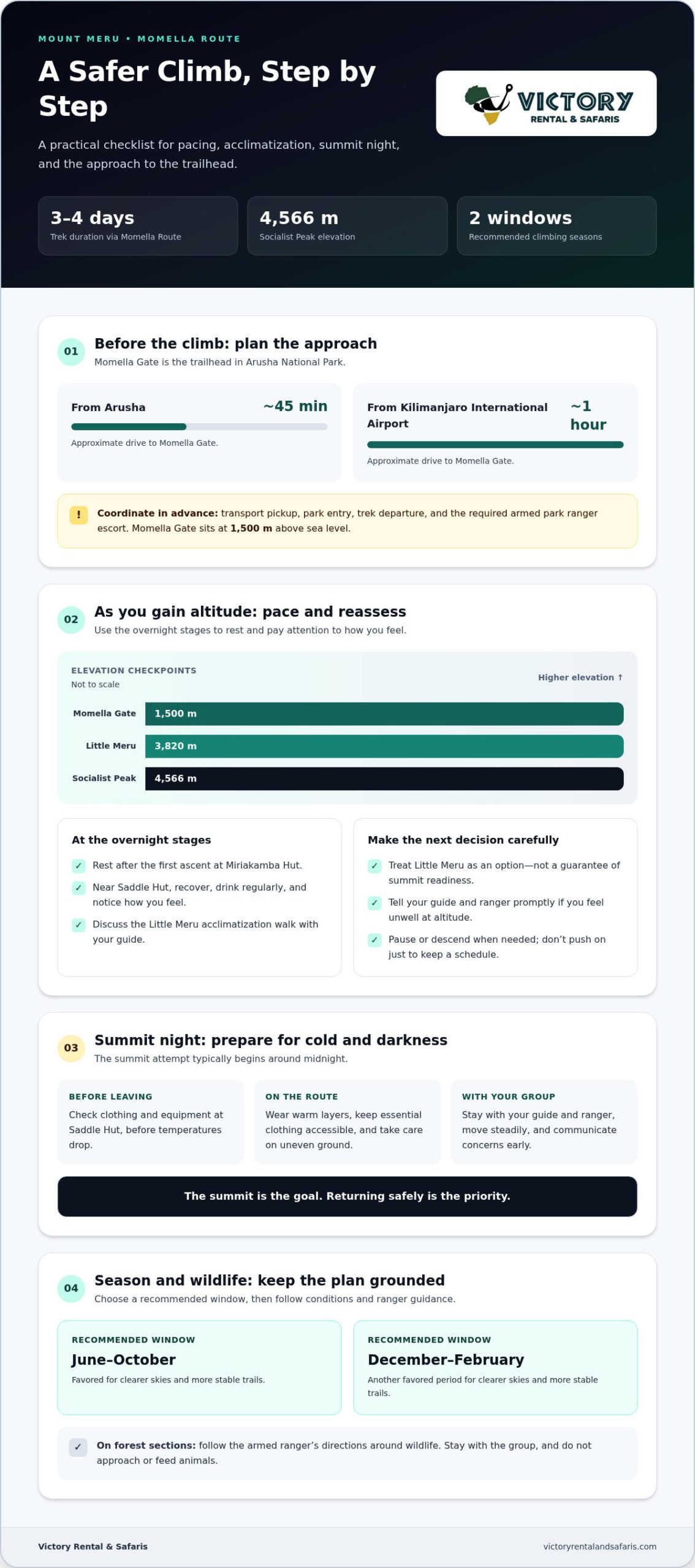
Momella Gate, the Mount Meru trailhead in Arusha National Park, sits at 1,500 m above sea level. From Arusha, the drive takes about 45 minutes; from Kilimanjaro International Airport, allow about one hour. These approach journeys make the gate accessible from both the city and the airport, but transport timing still matters. Plan your arrival so the drive, park-entry arrangements, and trek departure fit together.
Mount Meru climbers must be accompanied by an armed park ranger. Treat this escort as a required part of the climb, not an optional extra. Keep the ranger requirement distinct from arrangements for permits and licensed guides, and organize park access and trek logistics before setting out for Momella Gate.
Arusha is a practical staging point because it lies close to the trailhead and connects with other northern Tanzania journeys. For example, the city can also serve as a starting point for travel toward Serengeti National Park. Keep the Mount Meru transfer separate in your schedule, so another excursion doesn’t compress the time available for reaching the gate.
The short drive from Arusha can make the trailhead seem close, but the journey is only one part of the day. Your departure time, transport pickup, and park-entry arrangements all affect when you reach Momella Gate. Keep these details in one itinerary rather than relying on separate messages or assumptions. This makes the transition from road travel to the mountain approach easier to manage.
If you’re arriving through Kilimanjaro International Airport, plan the transfer around your arrival and the trek’s start arrangements. The drive is about one hour, while the trip from Arusha takes about 45 minutes. These are useful planning estimates, not a reason to leave transport until the last moment. Confirm the pickup location, destination, and timing in advance, then keep the ranger escort in the same plan. A clear approach makes the first steps from Momella Gate feel less hurried and sets up the climb ahead.
Key risks on Mount Meru include altitude illness, cold, wildlife encounters, and challenging summit conditions. An armed park ranger accompanies climbers. A measured pace, warm clothing, and attention to changing conditions also help you manage the climb.
Little Meru reaches 3,820 m near Saddle Hut, offering a higher point for an acclimatization walk. The main summit, Socialist Peak, rises to 4,566 m. That elevation gain makes pacing important: use the hut stop to rest, drink regularly, and notice how you feel before continuing higher. Little Meru can be part of the plan, but reaching it doesn’t guarantee that your body is ready for the summit.
Altitude illness can affect your ability to continue safely. Don’t treat the itinerary as a race or push on to meet a fixed schedule. If you feel unwell at altitude, tell your guide and ranger promptly, then follow their safety instructions. Pausing or descending when needed matters more than reaching a particular point.
Cold is especially important during the summit attempt, which typically begins around midnight. Darkness, fatigue, and exposed conditions can make moving more demanding. Wear suitable warm layers, keep essential clothing accessible, and follow your guide’s pace rather than rushing to keep up. Check your clothing and equipment before leaving Saddle Hut, not after the temperature drops.
Wildlife is part of the lower mountain environment. Follow the armed ranger’s instructions, don’t approach animals, and stay with the group. Higher on the route, cold, fatigue, and footing in darkness become the main concerns. Take care on uneven ground and keep your attention on the trail.
Use Little Meru as a decision point, not a promise of summit success. Rest, assess honestly how you feel, and keep a steady pace before deciding whether to continue higher. On Mount Meru, reaching the summit is a goal, but returning safely is the priority.
The recommended climbing windows for Mount Meru are June-October and December-February. These periods are favored for clearer skies and more stable trails. Use them as a seasonal guide, while also accounting for your travel schedule and trek logistics. Choose a window, then plan your arrival and hut itinerary around it.
To plan a Mount Meru trek in 2026, allow 3-4 days via the Momella Route to Socialist Peak at 4,566 m. June-October and December-February are the recommended periods, with park entry for non-residents listed at approximately US$50 per day in 2024. Treat that dated fee as a reference, and use the current official tariff for your travel dates.
For budgeting purposes, these are the current figures to plan around — always confirm against the official TANAPA tariff before paying a deposit, as park fees can change each July:
| Item | Current figure (per person unless noted) |
|---|---|
| Arusha National Park entry | ~US$47–50/day (non-resident adult) |
| Hut fees (Miriakamba / Saddle Hut) | ~US$30–60/night |
| Mandatory armed ranger | ~US$20–30 per group per day (shared across your party) |
| Guide, cook and porters | included in organized treks; tips US$80–150 per trek |
| Fully organized 3-day trek (park fees, huts, ranger, meals, transfers from Arusha) | US$1,000–1,600 |
| Fully organized 4-day trek (extra acclimatization, higher summit odds) | US$1,200–1,900 |
A Kilimanjaro climb typically starts around US$2,000–2,900 — Meru delivers a real 4,500m+ summit at roughly half the price, and works as ideal acclimatization if Kilimanjaro follows 3–5 days later.
June-October gives you a broad stretch of months to plan around. Compare your preferred dates with the trek duration and transport arrangements, and leave breathing room around the climb. A favorable season can support your plans, but the ascent to Socialist Peak remains physically demanding.
December-February is another recommended window if the middle of the year doesn’t suit your calendar. Consider how your dates fit with arrival, the hut schedule, and onward travel. Keep the itinerary realistic rather than squeezing the climb between fixed connections.
A complete 2026 Mount Meru trek plan should bring together the 3-4-day Momella Route, Socialist Peak, seasonal timing, and the relevant park-fee schedule. For the fee component, rely on the official tariff applicable to your dates rather than treating the 2024 figure as current.
Compare the actual itinerary, not just the season. A tight schedule leaves less room around travel, while a well-spaced plan makes the climb easier to fit into your wider journey. Check how your chosen dates align with hut stays and the summit attempt. These practical details help turn a seasonal preference into a workable 2026 plan.
The standard Momella Route trek takes 3 to 4 days, depending on the itinerary. It begins at Momella Gate, at 1,500 m, and climbs to Socialist Peak at 4,566 m. That’s a net elevation difference of 3,066 m between trailhead and summit; it isn’t the route’s cumulative ascent, which also depends on the trail’s rises and descents. The high altitude and long summit stage make this a physically demanding trek.
A typical four-day plan gives the hut stages room to unfold. From Momella Gate, the first listed leg reaches Miriakamba Hut after 10 km and 4-5 hours. The next leg covers 6 km to Saddle Hut in 3-4 hours. These stages build elevation gradually, though the second day still requires sustained uphill walking. Take the time estimate as a guide to the day’s effort, not as a reason to hurry.
The summit day is the most demanding section. The trek from Saddle Hut to Socialist Peak and down to Miriakamba Hut takes 10-12 hours. Starting around midnight means walking through darkness before dawn, then continuing after reaching the peak. Build the schedule around this full effort rather than treating the summit as a short walk from camp.
The elevations show how the route changes: Momella Gate is at 1,500 m, Miriakamba Hut at 2,514 m, Saddle Hut at 3,570 m, and Socialist Peak at 4,566 m. The climb from Saddle Hut to the summit gains 996 m in elevation. That upper stretch follows the overnight ascent, so rest at the hut and a steady pace are central to the day.
A 3-day itinerary offers less time across the route than a 4-day plan. Compare the nights at Miriakamba and Saddle, the summit-day effort, and the descent arrangement before choosing. The listed 10-12-hour summit day already combines the ascent to Socialist Peak with the descent to Miriakamba Hut. Keep that demanding segment in view when deciding how much time to allow for the full trek.
For a clear itinerary, check that the plan names each hut, the summit attempt, and the descent endpoint. The stated route segments provide useful benchmarks, while the overall schedule determines how they fit into 3 or 4 days. A well-paced plan makes the progression from the forested approach to the high volcanic summit easier to understand before setting out.
The Momella Route uses two mountain huts: Miriakamba Hut at 2,514 m and Saddle Hut at 3,570 m. Their elevations mark the climb’s overnight progression, from the first ascent to a higher camp before summit night. Staying at these named huts gives the itinerary clear stopping points, while each change in elevation makes rest and preparation important.
Miriakamba Hut is the first overnight stop on the standard route. After arriving, organize the next day’s clothing and essentials, then settle in to rest. Keep morning items accessible rather than packing them away. An orderly stop makes it easier to leave without searching through your bag.
Saddle Hut sits higher, near Little Meru at 3,820 m. It’s the staging point before the summit attempt, which typically starts around midnight. Prepare warm layers, water, and anything needed during the night before resting. The early departure makes a simple, ready-to-use setup more useful than sorting equipment in darkness.
Treat that as a dated tariff, not an assumed 2026 charge. Park and accommodation tariffs can change, so compare the official TANAPA tariff for your travel dates before paying a deposit. Keep hut accommodation distinct from park charges when reviewing a trek’s itemized costs.
Hut nights also influence your pace. The route climbs from Miriakamba to Saddle Hut, followed by a short overnight rest before the summit attempt. Keep your sleep kit, clothing, and personal items organized so you can settle quickly at each stop. Before summit night, place essential layers where you can reach them easily at Saddle Hut.
Before departure, make sure your itinerary identifies both Miriakamba Hut and Saddle Hut, and shows which nights you’ll stay at each. That simple detail helps you match your packing to the route and understand where each rest period falls. For help shaping the hut-based itinerary, plan your Mount Meru climbing tour around the route’s overnight stages.
| Mount Meru | Kilimanjaro | |
|---|---|---|
| Summit | 4,566m | 5,895m |
| Duration | 3–4 days | 5–8 days |
| Accommodation | Park huts (bunks) | Tents or huts |
| Cost (organized, per person) | US$1,000–1,900 | US$2,000–4,200 |
| Crowds | Low | High |
| Distinctive feature | Wildlife on the trail + crater-rim sunrise with Kilimanjaro on the horizon | Africa’s highest point |
Meru’s summit night is steeper and involves some scrambling on the crater rim — but over 3–4 days rather than 6–8, and 1,300m lower, which means a far lower altitude-sickness risk. Climb Meru first and Kilimanjaro 3–5 days later, and you arrive on Kili already acclimatized — a combination our guests consistently rate as the smartest way to do both mountains. February and September–October are the windows when both are at their best.
Victory Rental & Safaris can help plan the next part of your Tanzania journey after Mount Meru. If you’re ready to trade high mountain trails for open savannah, explore the Serengeti Great Migration experience or Great Migration Tanzania Tour. The Masai Mara to Serengeti & Ngorongoro Safari Adventure is another way to connect wildlife destinations in one journey.
When you’re ready to plan beyond the climb, choose a safari based on your preferred destinations and travel dates. The transition from Mount Meru to the Serengeti brings a striking change of scenery, from volcanic slopes to wildlife-rich plains. Explore the safari options, then contact Victory Rental & Safaris to discuss your plans.
Planning a Mount Meru trek in 2026 is also a chance to think about what you want your time in Tanzania to feel like beyond the mountain. You might return home with the summit as the whole story, or let the climb open into another kind of adventure. Give that next chapter its own purpose, whether you’re drawn to wildlife, wide landscapes, or time by the coast.
Before committing, bring your priorities together: the experience you want most, the pace that suits you, and the destinations you hope to discover. This makes it easier to plan a cohesive journey rather than an overcrowded one. Victory Rental & Safaris can help you explore Tanzania safari experiences as a natural continuation of your climb.
Explore your next Tanzania adventure, and take the first step toward a journey that stays with you long after the trail ends.
A three-day itinerary climbs from Momella Gate to Miriakamba Hut, continues to Saddle Hut, then attempts the summit before descending. The summit stage starts around midnight and includes the climb to Socialist Peak and descent to Miriakamba Hut. Check how the itinerary schedules the final return to the gate. If you’re comparing mountain routes in Tanzania, you can also explore Kilimanjaro climbing routes.
A four-day plan spreads the route stages over more time than a three-day itinerary. Both include overnight stops at Miriakamba and Saddle huts, but schedules can differ in how they arrange the summit attempt and descent. Compare the daily stages and overnight sequence before choosing. A broader Tanzania itinerary can help you see how the climb fits with other travel.
Budget around US$47–50 per person per day for Arusha National Park entry, US$30–60 per night for the mountain huts, and US$20–30 per group per day for the mandatory armed ranger. Organized treks quote one package price covering all of these. The TANAPA tariff updates periodically (typically each July), so confirm the current figures for your dates before paying a deposit — your operator should show you the itemized breakdown.
A fully organized 3-day Mount Meru trek runs US$1,000–1,600 per person, and the 4-day version US$1,200–1,900, typically including park fees, hut nights, ranger, guide and cook team, all meals, and transfers from Arusha. Tips (US$80–150 per trek) and personal gear are the main extras. That’s roughly half the cost of a Kilimanjaro climb — and if you combine Meru with a Kili trek 3–5 days later, the acclimatization boost is free.
The recommended climbing windows are June-October and December-February, periods associated with clearer skies and more stable trails. The available seasonal guidance doesn’t provide a separate weather forecast for each month. Choose dates within a recommended window, then plan your clothing and travel arrangements around the route’s elevation changes and overnight summit attempt. For onward wildlife travel, you can explore Serengeti National Park.
Prepare with regular uphill walks and practice carrying the pack you intend to take. On the mountain, keep a measured pace, rest at overnight stops, and tell your guide if you feel unwell. Pack warm layers where they’re easy to reach for the night summit start. These practical habits help you prepare, but don’t replace professional guidance about altitude-related symptoms.
Momella Gate is about a 45-minute drive from Arusha and about an hour from Kilimanjaro International Airport. The route’s overnight huts are Miriakamba and Saddle, so include both in your packing and transfer plans. If you’re extending your Tanzania trip after the climb, Ngorongoro Crater travel is another wildlife destination to consider.
{
“@context”: “https://schema.org”,
“@type”: “FAQPage”,
“mainEntity”: [
{
“@type”: “Question”,
“name”: “What is the 3-day Momella Route itinerary to Socialist Peak on Mount Meru?”,
“acceptedAnswer”: {
“@type”: “Answer”,
“text”: “A three-day itinerary climbs from Momella Gate to Miriakamba Hut, continues to Saddle Hut, then makes the summit attempt before descending. The summit stage starts around midnight and combines the climb to Socialist Peak with the descent to Miriakamba Hut. Check how the itinerary schedules the final return to the gate. Trekkers comparing Tanzania mountain routes can also explore Kilimanjaro climbing routes.”
}
},
{
“@type”: “Question”,
“name”: “What is the 4-day Mount Meru trek itinerary and how does it differ from 3 days?”,
“acceptedAnswer”: {
“@type”: “Answer”,
“text”: “A four-day plan spreads the route stages across more time than a three-day itinerary. Both include the Miriakamba and Saddle hut stops, but schedules can differ in how they place the summit attempt and descent. Compare the daily stages and overnight sequence before choosing. A broader Tanzania itinerary plan can help you consider how the climb fits with other travel.”
}
},
{
“@type”: “Question”,
“name”: “What are the current 2026 Mount Meru National Park entry, camping, rescue, and guide fees?”,
“acceptedAnswer”: {
“@type”: “Answer”,
“text”: “Use the official TANAPA tariff for your travel dates to establish current entry, camping, rescue, and guide charges. Older fee figures shouldn’t be treated as current 2026 prices, and any quoted park fees should be VAT-inclusive. Review the official TANAPA tariff information before paying a deposit, and compare each fee category with the written trek inclusions.”
}
},
{
“@type”: “Question”,
“name”: “What is the total estimated cost of a Mount Meru trek in 2026, including guides, porters, transport, and gear?”,
“acceptedAnswer”: {
“@type”: “Answer”,
“text”: ” That package price alone doesn’t establish which individual costs are included. Compare the written inclusions with your needs, especially transport, porter support, gear, park fees, and hut charges. Keep excluded items separate when estimating your overall trip budget, and use the official tariff for park charges.”
}
},
{
“@type”: “Question”,
“name”: “When is the best time to climb Mount Meru from June through February, and what are the weather conditions by month?”,
“acceptedAnswer”: {
“@type”: “Answer”,
“text”: “The recommended climbing windows are June-October and December-February, periods associated with clearer skies and more stable trails. The available seasonal guidance doesn’t provide a separate weather forecast for each month. Choose dates within a recommended window, then plan your clothing and travel arrangements around the route’s elevation changes and overnight summit attempt. For onward wildlife travel, you can explore Serengeti National Park.”
}
},
{
“@type”: “Question”,
“name”: “How should trekkers prepare for Mount Meru, including fitness training, acclimatization, packing, and altitude sickness prevention?”,
“acceptedAnswer”: {
“@type”: “Answer”,
“text”: “Build your preparation around regular uphill walking and practice carrying the pack you intend to take. Follow a measured pace on the mountain, rest at overnight stops, and tell your guide if you feel unwell. Pack warm layers where you can reach them easily for the night summit start. These practical habits support readiness, but they don’t replace professional guidance about altitude-related symptoms.”
}
},
{
“@type”: “Question”,
“name”: “How do you travel to Momella Gate from Arusha or Kilimanjaro Airport, and what accommodation is available on the route?”,
“acceptedAnswer”: {
“@type”: “Answer”,
“text”: “Momella Gate is about a 45-minute drive from Arusha and about an hour from Kilimanjaro International Airport. The route’s overnight huts are Miriakamba and Saddle, so include both in your packing and transfer plans. If you’re extending your Tanzania trip after the climb, Ngorongoro Crater travel is another wildlife destination to consider.”
}
}
]
}