
Tanzania is now under a U.S. Level 2: Exercise Increased Caution advisory. The U.S. Department of State downgraded it in October 2026 from Level 3. Whether Tanzania is safe for American tourists in 2026 still depends on the places you visit, how you travel, and the precautions you take, but the lower level is welcome news for most itineraries.
It’s natural to picture golden savannas, wildlife encounters, and quiet stretches of Zanzibar’s coast while planning a trip. Practical questions belong in that picture, too. Knowing what to expect before departure can help you make choices that suit your itinerary and travel style, without letting uncertainty eclipse the experience you’re hoping to have.
This guide explains how to interpret the U.S. travel advisory and assess safety in different settings. It also covers health preparation, road travel, urban crime, personal and financial precautions, and local laws and customs, with destination tips for safari parks, Kilimanjaro and Zanzibar.
For Americans wondering whether Tanzania is safe for American tourists in 2026, the practical answer depends partly on health preparation and the route. Malaria, mosquito bites, entry health screening, and insurance requirements all deserve attention before departure. These considerations apply whether your plans feature a safari, Zanzibar’s beaches, or time in towns. Prepare around the places you’ll visit, rather than treating health precautions as a last-minute packing task.
Malaria risk covers areas below 1,800 m, including Zanzibar and major safari parks. Before traveling, ask a healthcare professional about prescription anti-malaria pills and how to use them for your itinerary. Carry insect repellent and apply it as directed. Use additional bite-prevention measures recommended for your destination, such as covering exposed skin when appropriate. Travelers are advised not to drink tap water, so plan safe drinking water for drives, excursions, and stays away from your accommodation.
Malaria prevention matters on an island holiday, too. Two of six travelers who returned to Italy after contracting falciparum malaria in Zanzibar died between December 2023 and February 2025. That report describes a specific group, not an individual traveler’s outcome. It nevertheless shows why visitors shouldn’t skip bite prevention because they’re staying near beaches or spending most of their time indoors.
Check how your route affects entry screening. Tanzania requires proof of yellow-fever vaccination from travelers arriving from or transiting through a yellow-fever-risk country. Since May 19, 2026, travelers arriving from or transiting Uganda or the Democratic Republic of Congo have been required to complete a surveillance form and undergo temperature screening. Keep your travel route and vaccination documents together, so you can present relevant information during arrival procedures.
Travel insurance is mandatory for travel to Tanzania. If you’re staying in Zanzibar, include the island’s inbound insurance requirement in your arrival preparations, alongside your other travel documents. Keep policy details accessible during the trip, including when transferring between mainland destinations and Zanzibar. Knowing where to find your paperwork can make it easier to arrange assistance if your plans are interrupted.
To judge whether Tanzania is safe for American tourists in 2026 for your own plans, make health preparation specific to your itinerary. Discuss malaria prevention, vaccination needs, and existing conditions with a healthcare professional before departure. Pack prescribed medication as directed and keep medical information accessible. Each day, use repellent as directed and choose safe drinking water. These practical habits help you prepare for the different settings on a journey, from wildlife-rich parks to Zanzibar’s coast.
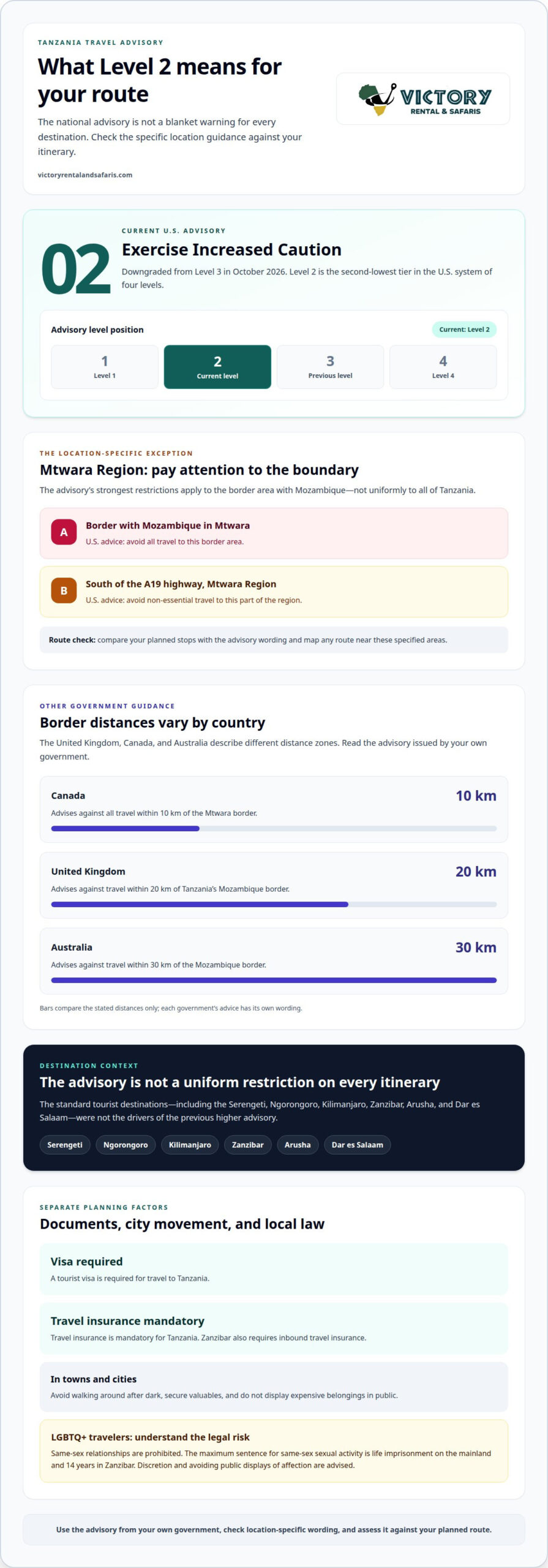
The U.S. Department of State now rates Tanzania Level 2: Exercise Increased Caution. The advisory was downgraded in October 2026 from Level 3. The U.S. system has four levels, and Level 2 is its second-lowest tier. The standard tourist destinations, including the Serengeti, Ngorongoro, Kilimanjaro, Zanzibar, Arusha and Dar es Salaam, were not the drivers of the previous higher advisory.
Location still matters. The advisory continues to warn travelers to avoid all travel to the border with Mozambique in Mtwara Region. It also advises against non-essential travel to the part of Mtwara Region south of the A19 highway. These are specific geographic cautions, not a warning that every destination in Tanzania faces the same restrictions.
Western governments describe the border risk differently. The United Kingdom advises against travel within 20 km of Tanzania’s Mozambique border, while Canada advises against all travel within 10 km of the Mtwara border. Australia advises against travel within 30 km of the Mozambique border. Those distances differ, so travelers should read the advisory issued by their own government and map any planned route against its wording.
Entry planning involves separate requirements. A tourist visa is required to travel to Tanzania, and travel insurance is mandatory. Zanzibar also requires inbound travel insurance, so account for it when planning an island stay. These entry and insurance rules are distinct from the U.S. advisory level. Arrange your documents before departure and keep relevant policy details accessible during travel.
Social and legal risks deserve careful consideration, particularly for LGBTQ+ travelers. Tanzania prohibits same-sex relationships. The maximum sentence for same-sex sexual activity is life imprisonment on the mainland and 14 years in Zanzibar. Discretion and avoiding public displays of affection are advised.
For city travel, include simple precautions in the plan: avoid walking around after dark, keep valuables secured, and don’t display expensive belongings in public. These steps address common personal-safety concerns and are separate from the Mtwara border warning. Compare your route with the current advisory, note any restricted areas, and plan city movements around daylight.
Tanzania’s national advice is to exercise a high degree of caution, whatever your nationality. For Americans, the U.S. Level 2 advisory (Exercise Increased Caution), issued in October 2026 after Level 3, fits the same approach. Dar es Salaam, Arusha, Zanzibar, national parks, and Mount Kilimanjaro each involve different practical considerations, covered below.
Road travel deserves particular attention. Tanzania’s roads may have potholes, poor lighting, inadequate signs, stray animals, motorcycles, bicycles, and pedestrians. Conditions can change along a route, so allow flexibility and avoid assuming that a short distance means a quick, straightforward drive. The World Health Organization estimated 10,052 road deaths in Tanzania in 2021, compared with 1,368 reported by the country. These figures use different reporting estimates, but both underline the need for care.
Public transportation can make journeys between airports, cities, and safari destinations less predictable. Avoid it when possible, and use pre-arranged transfers or game vehicles for safari travel. If you’re driving yourself, plan stops before setting out, pay attention to changing road conditions, and avoid driving after dark. For more, see our guide to car rental in Tanzania.
In national parks such as Serengeti and Ngorongoro, follow wildlife instructions from park staff and professional guides. Keep to the guide’s directions during game drives, and never approach wildlife independently. On Kilimanjaro, altitude is a distinct safety concern: 47% of climbers tested positive for acute mountain sickness at 4,730 m. Take symptoms seriously, tell your team how you feel, and follow their decisions.
Zanzibar’s beaches and coastal setting differ from busy streets in Dar es Salaam or Arusha, but plan transport and follow local guidance. Keep your itinerary and accommodation details accessible, and know how to reach your travel companions if plans change. See our Zanzibar holiday page for island options.
In an emergency, call Tanzania’s assistance number, 112, and give your location and the nature of the incident. Americans needing consular assistance should contact the U.S. Embassy in Dar es Salaam using its official contact information, saved before travel.
In Dar es Salaam and other urban areas, build simple security habits into each day’s plans. Visitors are advised to avoid walking around cities after dark. Arrange transport back to your accommodation instead of setting out on a late walk through unfamiliar streets. During the day, stay alert in crowded markets and transport hubs, and keep your bag close to reduce the risk of someone snatching it unnoticed.
Keep valuables in your room safe and avoid displaying expensive belongings in public. Before leaving your room, carry only what you need for the outing, such as one payment card and a modest amount of cash. Store your passport securely and keep a separate record of its details. A camera or phone can attract attention, so put it away between photographs instead of carrying it openly.
Plan cash access carefully. Use an ATM in a staffed, well-lit location, and shield the keypad while entering your PIN. Put your cash away before leaving the machine. Don’t count money on the street or leave a wallet visible in a vehicle. If a payment terminal is brought to your table, watch the transaction and keep your card in sight.
Bag snatching and pickpocketing are practical concerns in cities, while standard safari and island routes were not the drivers of the earlier advisory. Treat personal security as a set of repeatable choices. Keep your phone, wallet, and bag secure, and choose busy, well-lit places when meeting someone or waiting for transport.
For evening plans in Dar es Salaam, Arusha, or another town, decide how you’ll return before going out. Ask your accommodation to arrange transport, share your destination with a travel companion, and keep your phone charged. If unwanted attention, including sexual harassment, makes you uncomfortable, move to a staffed public place and contact someone you trust. Don’t stay isolated while trying to resolve the situation alone.
After a theft, move to a secure place and contact local authorities for assistance. If a bank card or phone is missing, use your bank’s or mobile provider’s official channel to block access as soon as possible. Keep key contact details separate from your wallet, so losing one item doesn’t leave you without a way to respond.
Local rules can affect ordinary moments, from packing a shopping bag to taking a picture. Tanzania bans single-use plastic bags, including those packed in travelers’ luggage. Before flying, remove disposable plastic carrier bags from your suitcases and daypacks, and choose reusable alternatives for toiletries or laundry.
Prescription medication requires the same care. Before departure, check whether each medicine is legal to bring into Tanzania, and carry a doctor’s letter explaining the medication and its purpose. Keep medicines in their original packaging, with the letter accessible.
Online posts can also carry legal risks. Tanzanian law makes it a criminal offence to share online graphic, violent, or politically sensitive material that could embarrass the government. Use caution before posting or forwarding pictures, videos, or political commentary about events in Tanzania. Avoid sharing material when its context or source is unclear. A private group chat can still circulate content beyond its intended audience, so think carefully before pressing send.
Public behavior matters too. Couples are advised to avoid public displays of affection around locals. For LGBTQ+ travelers, Tanzania prohibits same-sex relationships, and the maximum sentence for same-sex sexual activity is life imprisonment on the mainland and 14 years in Zanzibar. Discretion is advised across both the mainland and Zanzibar.
On Zanzibar, clothing can draw official scrutiny. Visitors can face fines of US$700 or more for clothing authorities consider inappropriate, although that amount traces to a 2021 ministry announcement, not a published regulation. Choose clothing that covers shoulders and knees when visiting town or community settings, and keep beachwear for the beach. This practical choice shows respect and reduces the chance of misunderstanding.
Mount Kilimanjaro calls for thoughtful conduct, too. Follow the instructions of park staff and guides, and ask before photographing people or private spaces. A respectful approach generally means observing local cues, dressing with care, and avoiding arguments over customs. Learn these expectations before you travel, then apply them consistently in cities, villages, Zanzibar, and on the mountain. Small choices can help preserve the welcome and ease of your journey.
With Tanzania at Level 2 (Exercise Increased Caution) since October 2026, down from Level 3, the question is what kind of journey will feel right for you. Let your itinerary reflect your own pace, interests, and comfort with adventure.
Before you travel, turn what you’ve learned into a personal plan. Consider which destinations you want to experience, how you’ll get between them, and what preparations suit your route. Keep the Mtwara border region off your route.
If you’re ready to shape a Tanzania journey around the places that matter to you, contact Victory Rental & Safaris to explore your next step.
The U.S. Department of State lowered Tanzania to Level 2 (Exercise Increased Caution) in October 2026, from Level 3. A safari itinerary involves different transport and wildlife considerations from time in a city or on Zanzibar’s beaches, so prepare for health risks, keep travel documents accessible, and plan how you’ll move between destinations.
Female and solo travelers can make practical choices in cities. Arrange a return ride before an evening outing, avoid walking alone after dark, and share your plans with a trusted companion. If unwanted attention makes you uncomfortable, move to a staffed, well-lit place. Keep accommodation and transport details accessible rather than relying on a phone with a low battery.
Zanzibar also requires inbound travel insurance. Proof of yellow-fever vaccination is required if you arrive from or transit through a yellow-fever-risk country. Since May 19, 2026, travelers arriving from or transiting Uganda or the Democratic Republic of Congo complete a surveillance form and temperature screening. Travelers of other nationalities should also read their own government’s travel advice.
Zanzibar was not a driver of the earlier Level 3 advisory. Malaria risk covers Zanzibar, so bring prophylaxis advice from a healthcare professional and use repellent. Zanzibar has its own mandatory inbound travel insurance requirement, and the maximum sentence for same-sex sexual activity there is 14 years. Dress modestly in town, covering shoulders and knees, and keep beachwear for the beach. See our Zanzibar holiday page for island trip options.
No. The U.S. Level 2: Exercise Increased Caution advisory is not a travel ban. Before booking, read the advisory’s current wording, check whether your route enters the Mtwara border area, and arrange your visa and insurance.
The U.S. advisory advises against all travel to the border with Mozambique in Mtwara Region and against non-essential travel to the part of Mtwara Region south of the A19 highway. Map your route before travel and keep stops and transfers away from those areas. The Serengeti, Ngorongoro, Kilimanjaro, Zanzibar, Arusha and Dar es Salaam were not the drivers of the earlier higher advisory.
Tanzania is Level 2: Exercise Increased Caution for Americans as of October 2026, down from Level 3. Apply the right precautions at each stop: use professional guides and follow park staff instructions in national parks, plan transport instead of walking after dark in cities, and take altitude symptoms seriously on Kilimanjaro, telling your climbing team. See our Tanzania safari guide to choose your route.
The U.S. Department of State lowered Tanzania from Level 3: Reconsider Travel to Level 2: Exercise Increased Caution in October 2026. The level had risen from Level 2 in October 2025. The warning for the Mtwara border region near Mozambique continues, so read the advisory’s details rather than only the level number.