
What if the most rewarding moment on a Great Migration Tanzania tour isn’t a river crossing? The herds move through the Serengeti year-round, following rainfall and fresh grazing, so the experience changes with the season and landscape. A dramatic crossing may happen, but its timing and location can’t be guaranteed.
It’s easy to see why travelers dream of watching thousands of animals gather at a river. It’s just as natural to wonder what a safari feels like day to day, and whether the wildlife you hope to see will appear. A guided journey is about more than one anticipated sighting: it offers time in the wild, attentive observation, and the possibility of unexpected encounters along the way.
This guide focuses on the tour experience: what a well-constructed safari should include, how to compare prices and operators, what guided safari days can involve, and how to prepare for wildlife viewing without expecting a fixed script. For detailed month-by-month timing, use a dedicated 2026 Serengeti migration planning guide.
A Great Migration Tanzania tour is a guided safari centered on the Great Migration in Tanzania. Instead of following a fixed spectacle on a set date, it follows a living pattern across the Serengeti ecosystem. Vast herds travel in response to seasonal conditions and fresh grazing, and the places they gather shift with rainfall and animal movement.
That distinction shapes the experience. A river crossing is one possible dramatic moment, not the definition of the migration or a performance that can be scheduled for visitors. A rewarding journey might mean watching herds move across open grassland, noticing how the landscape changes, or spending time with a guide searching for wildlife. The wider journey matters as much as any single encounter.
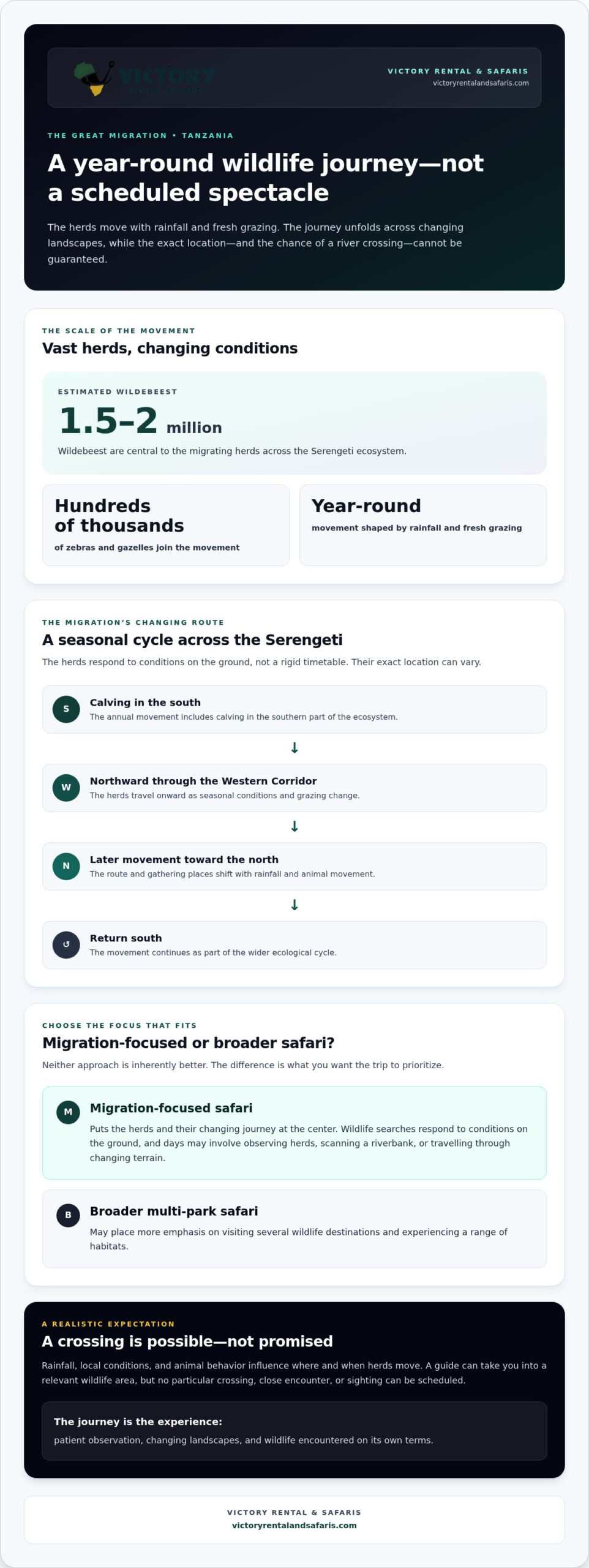
The Great Migration is the seasonal movement of wildebeest, zebras, and other wildlife across the Serengeti ecosystem in search of grazing. Wildebeest are central to the herds, joined by hundreds of thousands of zebras and gazelles. Estimates put the movement at about 1.5 to 2 million wildebeest, alongside the other migrating animals.
The herds follow changing conditions rather than a rigid route. Their movement unfolds across the year, with calving in the south, a northward journey through the Western Corridor, later movement toward the north, and a return south. The Serengeti National Park and the Great Migration are closely linked through this ecological cycle, but the animals’ exact location can vary.
A migration-focused safari puts the herds and their changing journey at the center of the wildlife experience. A broader safari may place more emphasis on visiting several wildlife destinations and seeing a range of habitats. Neither approach is inherently better. The difference is what you want the trip to prioritize.
On a movement-focused journey, the wildlife search responds to conditions on the ground. You might spend time observing a herd, scanning a riverbank, or travelling through changing terrain as the search continues. Sightings and daily experiences depend on where wildlife has moved, so a migration tour offers an opportunity to follow the spectacle, not a promise of a particular animal or event.
Keep that distinction in mind as you picture your ideal safari. If you want to experience the herds as part of a larger, changing landscape, the migration’s unfolding story can be compelling even without a dramatic crossing. Victory Rental & Safaris’ Great Migration Tanzania Tour is a guided way to engage with that moving wildlife story, rather than a fixed appointment with one moment.
A Great Migration Tanzania tour gives you the chance to watch wildlife on its own terms. Game drives aren’t timed performances, with animals appearing on cue; they are guided searches shaped by what is happening across the landscape. Some moments may be full of movement, while others call for patience: scanning the grass, listening, and noticing signs of life.
That quieter rhythm is part of the safari, not time between the “real” sightings. A vehicle may pause while the guide watches a distant herd or considers tracks, then continue through grassland, woodland, or open plains. Light and scenery shift through the day, and even a drive without a headline encounter can give you a closer sense of the ecosystem.
The migrating herds share the savanna with many other forms of wildlife. Depending on the area and conditions, you may notice grazing animals, predators, or birds, but no particular sighting is assured. Look beyond the largest gatherings: a distant shape on the plain, movement in the grass, or the contrast between open country and thicker vegetation can make the journey rewarding.
Give yourself time to observe. Watching how animals use the landscape, and how the scene changes as you travel, adds texture to a migration-focused safari. The experience isn’t only about counting sightings; it’s also about being present in a vast, living environment.
River crossings can be thrilling, but the herds decide when and where to cross. Rainfall, local conditions, and animal behavior influence their movement, and there’s no reliable way to schedule the moment for a tour. A guide can take you into a relevant wildlife area, but a crossing or close encounter remains a possibility, never a guaranteed itinerary feature.
Wildlife encounters vary because animals move in response to changing conditions, not a visitor’s schedule. That’s the realistic expectation to bring to a game drive. Waiting near a river may build anticipation, yet the herds might stay on the bank or move elsewhere. Appreciate the search and the surrounding wildlife rather than measuring the whole day by one event.
Flexibility helps. Follow your guide’s observations, stay curious if the route or pace changes, and treat each sighting as part of a larger story. For a guided way to experience the herds and the landscapes they travel through, explore Victory Rental & Safaris’ Great Migration Tanzania tour.
Tour descriptions vary, but a well-constructed Great Migration safari should state — in writing, before you pay — which of these it covers:
If an inclusion isn’t written down, it isn’t included. A professional operator answers “is X included?” with a line in the quote, not a shrug.
Two honest benchmarks for 2026:
The cheapest legitimate savings: travel in May, June, or November (strong wildlife, lower rates), fill the vehicle, and ask for the concession fee to be shown as its own line so you can compare like with like.
The difference between a good and bad migration tour is rarely the brochure — it’s these five things:
The right safari depends on what you want your days in Tanzania to be about. You might want to focus on the herds’ movement, experience a range of landscapes, or get a broader overview of wildlife destinations. Decide on that priority before comparing tours, then consider how travel between areas may affect the time available for wildlife viewing.
| Trip emphasis | Wildlife focus | Daily pace | Flexibility to consider |
|---|---|---|---|
| Migration-centered | Following the herds’ movement | Time for searching and observing | Wildlife locations can shift |
| Multi-park overview | A broader range of wildlife areas | Travel between destinations may take time | Less time may be spent in each area |
| Landscape variety | Different habitats and scenery | May balance travel with wildlife viewing | Emphasis depends on the trip’s design |
Ask yourself what you’ll most enjoy: concentrating on migration-related wildlife viewing, seeing varied scenery, or combining wildlife areas for a wider safari experience. These preferences clarify the trip’s overall emphasis. A migration-centered journey makes the herds’ changing movement the main wildlife interest; a multi-park overview puts more weight on visiting several destinations. Both can be rewarding, but they use your time and attention differently.
Victory Rental & Safaris’ Great Migration Tanzania Tour is designed for travelers who want Tanzania’s migration story at the center of their plans. As you consider it, focus on the experience you want rather than assuming the tour name means a particular animal encounter or fixed sequence of events.
A safari day is shaped by more than time spent watching animals. Road travel between areas, stops to observe wildlife, and the decision to wait or continue all influence its rhythm. A longer journey between destinations can mean less time searching in one place that day, while lingering over an unfolding sighting can make the day feel less predictable. Consider these trade-offs alongside the places you hope to experience.
A useful distinction is fixed highlights versus open-ended viewing. A tightly planned trip can make its intended stops clear, but wildlife doesn’t follow a timetable. A flexible approach leaves room to respond to changing conditions, though it can’t promise a particular sighting. Before choosing a Great Migration Tanzania tour, decide whether you’d rather prioritize a broad range of planned stops or let more of your attention follow wildlife activity as it unfolds.
Trip length matters for the same reason: every transfer uses time that could otherwise be spent observing. Consider how much of your available travel time you want to devote to moving between places, and how much you hope to spend exploring wildlife areas. That balance is personal. Choose the emphasis that feels right for your trip, and set realistic expectations that leave room for discovery.
A little preparation can make changing conditions feel like part of the adventure rather than a surprise. Before your Great Migration Tanzania tour, decide what matters most, pack for comfort in the season you’ll travel, and leave space for the day to unfold. Wildlife viewing calls for patience, so prepare practically without trying to script nature.
Choose clothing that feels comfortable outdoors and can adapt to changing conditions. Layers let you adjust as the day changes, while sun protection can make long periods in open country more comfortable. Binoculars may help you observe distant wildlife, and a camera is useful if you want to capture scenes. Neither is essential to appreciating the experience. Consider the season and planned journey as you pack, and make room for personal essentials that help you feel prepared.
Some drives may bring active wildlife viewing; others may involve searching, pausing, or moving through a landscape with fewer visible animals. Sightings, waiting times, and the day’s highlights can all vary. Rather than measuring the safari by one anticipated moment, give your attention to the full experience: distant movement, changing light, and the way wildlife uses its surroundings. Patience rewards careful observation.
Respectful viewing matters throughout. Listen to your guide’s instructions and follow their direction around wildlife. This helps keep the experience considerate of animals and others sharing the safari. Don’t treat a close approach or dramatic encounter as something to demand. Let the guide lead, stay attentive to your surroundings, and enjoy what the day offers.
Ready to shape your plans around a guided migration experience? Explore Victory Rental & Safaris’ Great Migration Tanzania Tour and consider the kind of journey you want.
Game-drive days follow a rhythm that rewards early risers:
It is a full, physical day — and most travelers describe it as the best kind of tired.
The Great Migration is a wildlife journey shaped by movement, changing landscapes, and moments that can’t be called to order. Victory Rental & Safaris is a Tanzanian tour operator offering guided Great Migration safaris, including the Great Migration Tanzania Tour. The tour focuses on exploring this remarkable spectacle while keeping expectations grounded in how animals move in the wild.
On a guided safari, observation is part of the day: watching the open plains, noticing signs of wildlife, and taking in how the scenery changes as you travel. The herds may be a powerful focus, but the journey can also draw your attention to the broader environment around them. A guide leads the wildlife experience, while the animals determine what appears and when.
This approach makes room for anticipation without turning it into a promise. A crossing or close encounter may be memorable, but it isn’t a scheduled feature. With curiosity and patience, you can value the unfolding landscape and the wildlife you encounter instead of measuring the experience against one expected scene.
As you explore the tour, consider what would make the journey meaningful to you. Are you most drawn to following the migrating herds, observing a range of wildlife, or experiencing the Serengeti’s changing scenery? Your priorities can help you think about the trip’s emphasis without assuming a particular sighting or itinerary.
It also helps to have your preferred travel period in mind. Migration phases shift with seasonal conditions, so your timing can inform which part of the wildlife story interests you most. Before exploring, note your preferred travel period, the encounters you hope for, and how open you are to a day unfolding differently than expected. These reflections can help you focus on the experience that suits your interests.
Victory Rental & Safaris offers a guided way to experience Tanzania’s moving wildlife spectacle through its Great Migration Tanzania Tour. Explore the tour details, keep your wildlife priorities in view, and take the next step toward a safari rooted in observation, discovery, and the freedom of the wild.
Explore the Great Migration Tanzania Tour
Some journeys stay with us not because every moment went to plan, but because they invited us to slow down and notice more. As you imagine your safari, look beyond the photograph you hope to bring home. What would it mean to watch the plains awaken, share an unhurried moment in the wild, or return with a story shaped by a place rather than a schedule? That curiosity can help turn a dream into a journey that feels your own.
Victory Rental & Safaris, a Tanzanian tour operator offering guided wildlife safaris, brings that spirit to its Great Migration Tanzania Tour. Let your wildlife interests and preferred travel period guide your plans, while leaving room for discoveries you can’t arrange in advance. Begin with a clear idea of what you hope to experience, held lightly enough for the unexpected to find its way in.
Explore the Great Migration Tanzania Tour and take the first step toward your own time in Tanzania’s extraordinary landscapes. A remarkable safari story is waiting to be imagined.
A Great Migration Tanzania tour is a guided safari focused on observing the migration within Tanzania. The herds move throughout the year rather than gathering for one scheduled event, so the experience varies with their location and surrounding conditions. Alongside wildebeest, travelers may encounter other wildlife and changing landscapes. Think of it as a guided opportunity to witness a living ecosystem, not a promise of a particular sighting or river crossing.
No, a river crossing can’t be guaranteed. The herds determine when and where to cross, and their decisions depend on animal movement and changing conditions. A migration-focused safari can include crossing country in its wildlife-viewing focus, but no tour can schedule the animals’ behavior with certainty. If a crossing doesn’t happen during your visit, look for other meaningful moments, from herd movement to quieter details in the surrounding landscape.
The best time depends on which part of the migration interests you and when you can travel. Herd locations shift throughout the year, so start with your wildlife priorities rather than choosing dates around an assumed fixed event. For example, decide whether you’re most curious about calving activity or the herds’ later movement north, then use seasonal timing information to refine your plans. These patterns can inform your decision, but they don’t guarantee a sighting.
There’s no single ideal length; it depends on your preferred safari rhythm, travel time, and how much of your trip you want to devote to wildlife viewing. For a more unhurried experience, consider how transfers could affect time spent observing animals. If your Tanzania visit has other priorities, balance those with safari time. Think about your overall travel plans first, then choose a pace that leaves room to enjoy the journey.
Wildebeest are central to the migration, and zebras and other wildlife may also be encountered along the way. What you see depends on where animals are moving and the conditions during your visit, so a species list shouldn’t be treated as a promise. The open savanna can offer rewarding observations beyond the migrating herds, too. Bring curiosity about the wider setting, and let each sighting add its own detail to the experience.
Pack practical layers, sun protection, and comfortable clothing suited to your travel season and planned activities. Binoculars can help you observe distant wildlife, while a camera is useful if you want to capture scenes, but neither is essential to enjoying the safari. Tailor your choices to your comfort and the conditions expected on your journey. A flexible wardrobe is often more helpful than packing for one imagined type of day.
Yes, a first-time traveler can enjoy a migration-focused safari if they’re comfortable with changing wildlife activity and a flexible daily rhythm. Consider how you feel about road travel, time spent observing, and periods when animals may be distant or less visible. These expectations can help you decide whether the experience suits you. Explore Victory Rental & Safaris’ Great Migration Tanzania Tour as you plan.
Budget roughly $300–$550+ per person per day for a complete mid-range guided tour in migration season — approximately $2,000–$3,500 per person for a 6–7 day trip. That includes park fees, vehicle, guide, full-board accommodation, and transfers. Luxury camps in prime crossing positions run considerably higher. Traveling in May, June, or November can cut costs by a third or more with minimal wildlife compromise.
Plan a minimum of 4–5 days with at least 3 full days in or around the Serengeti. If a Mara River crossing is the goal, spend 3–4 nights in the northern Serengeti during July–October — crossings are unpredictable, and extra days in the right region are the only proven way to improve your odds. Shorter trips are possible but turn the migration into a gamble rather than an experience.